The Collection / Language & Literature
Language & LiteraturePaper 1 in Seven Stations
One page, seven stations, and a time budget on every one of them. Not a list of things a good answer contains — a route through the exam that tells a student when to stop annotating and start writing.
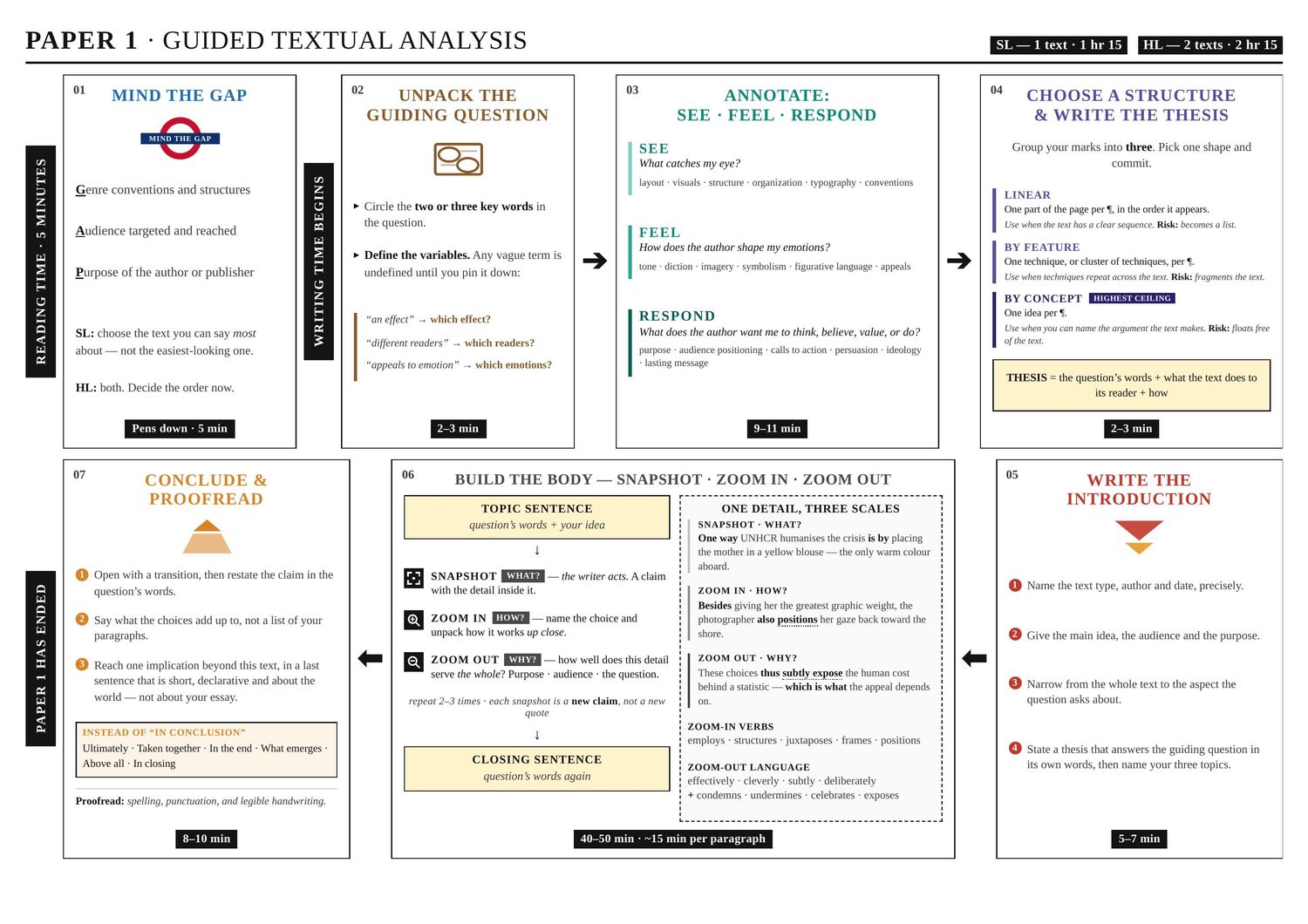
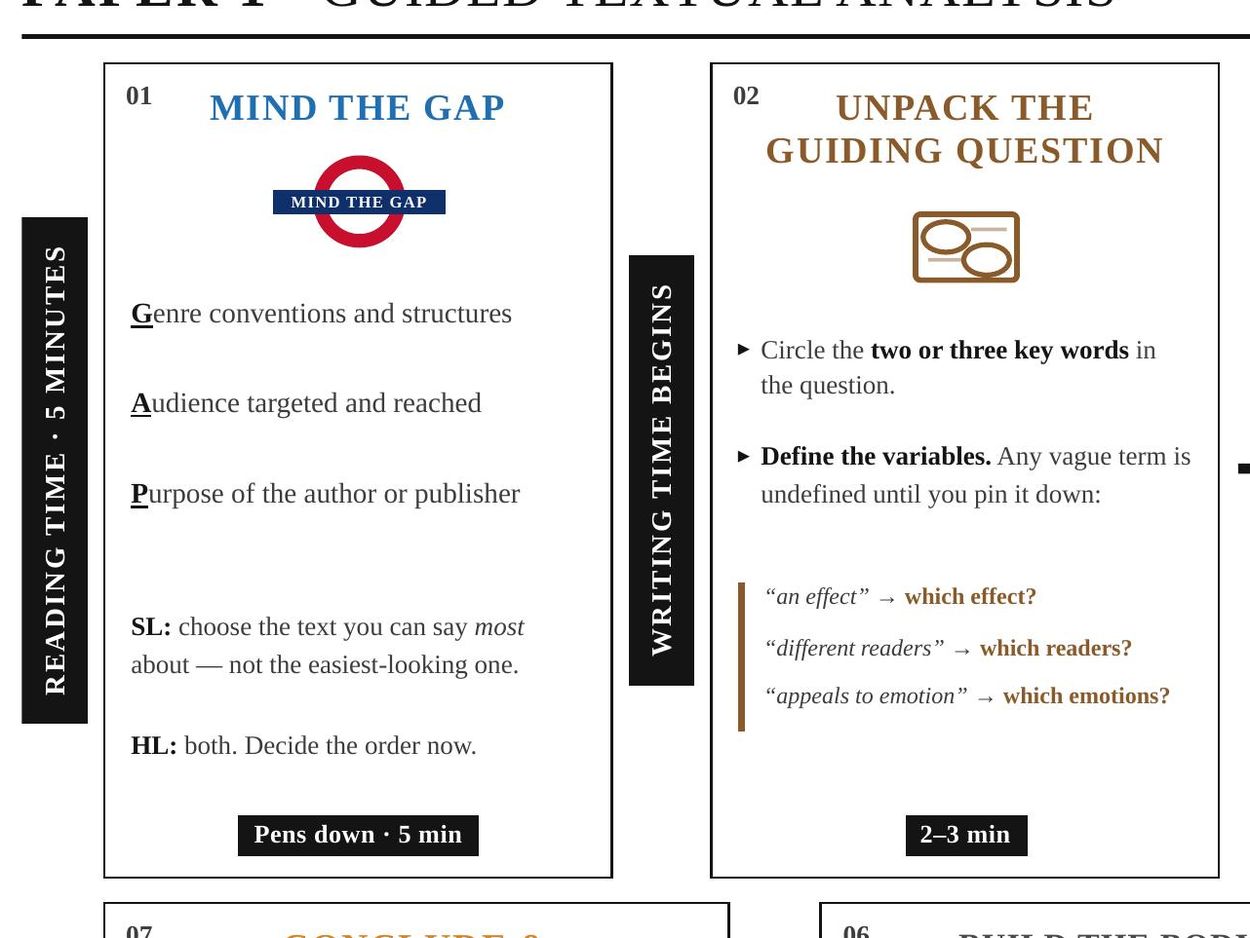
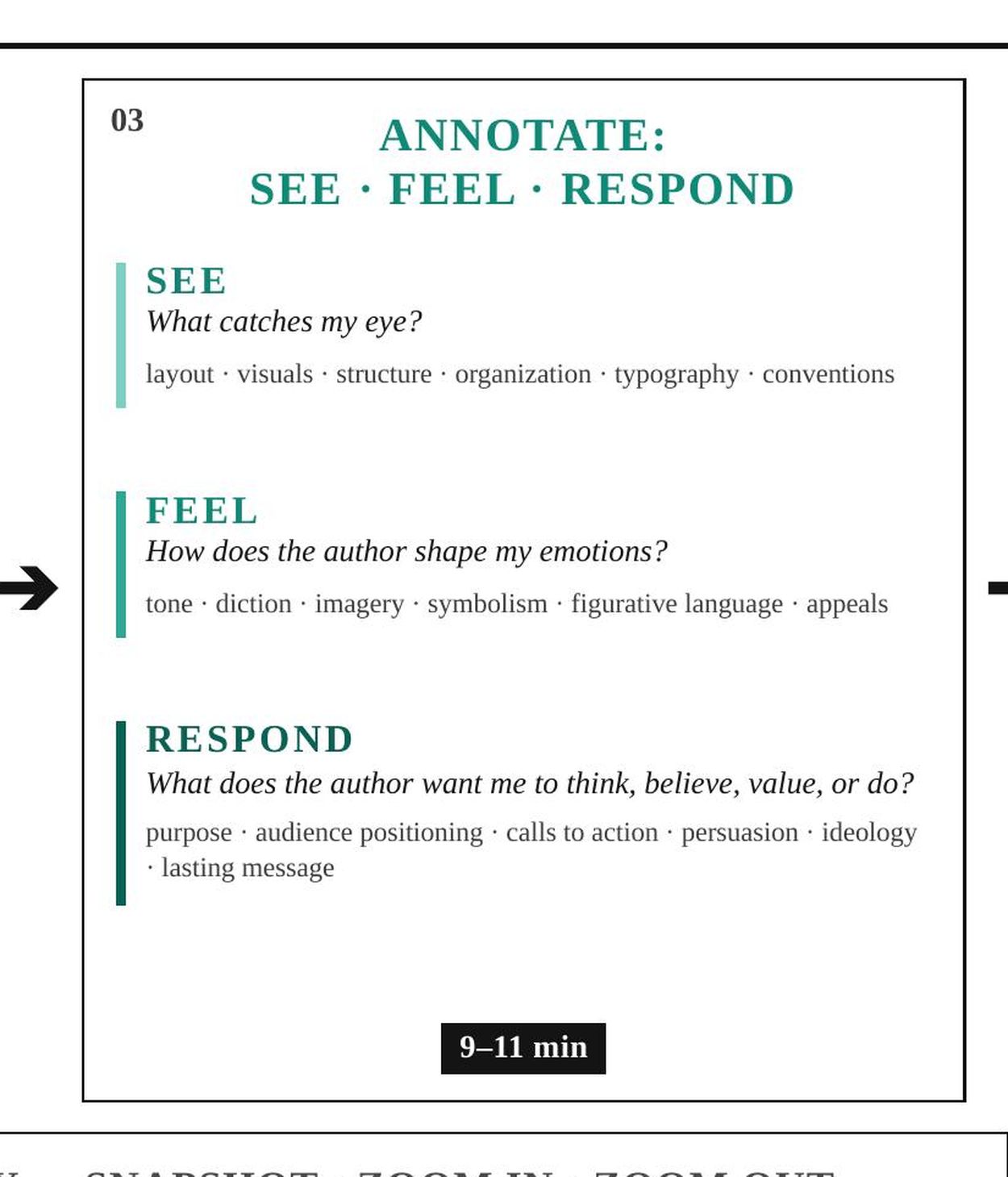
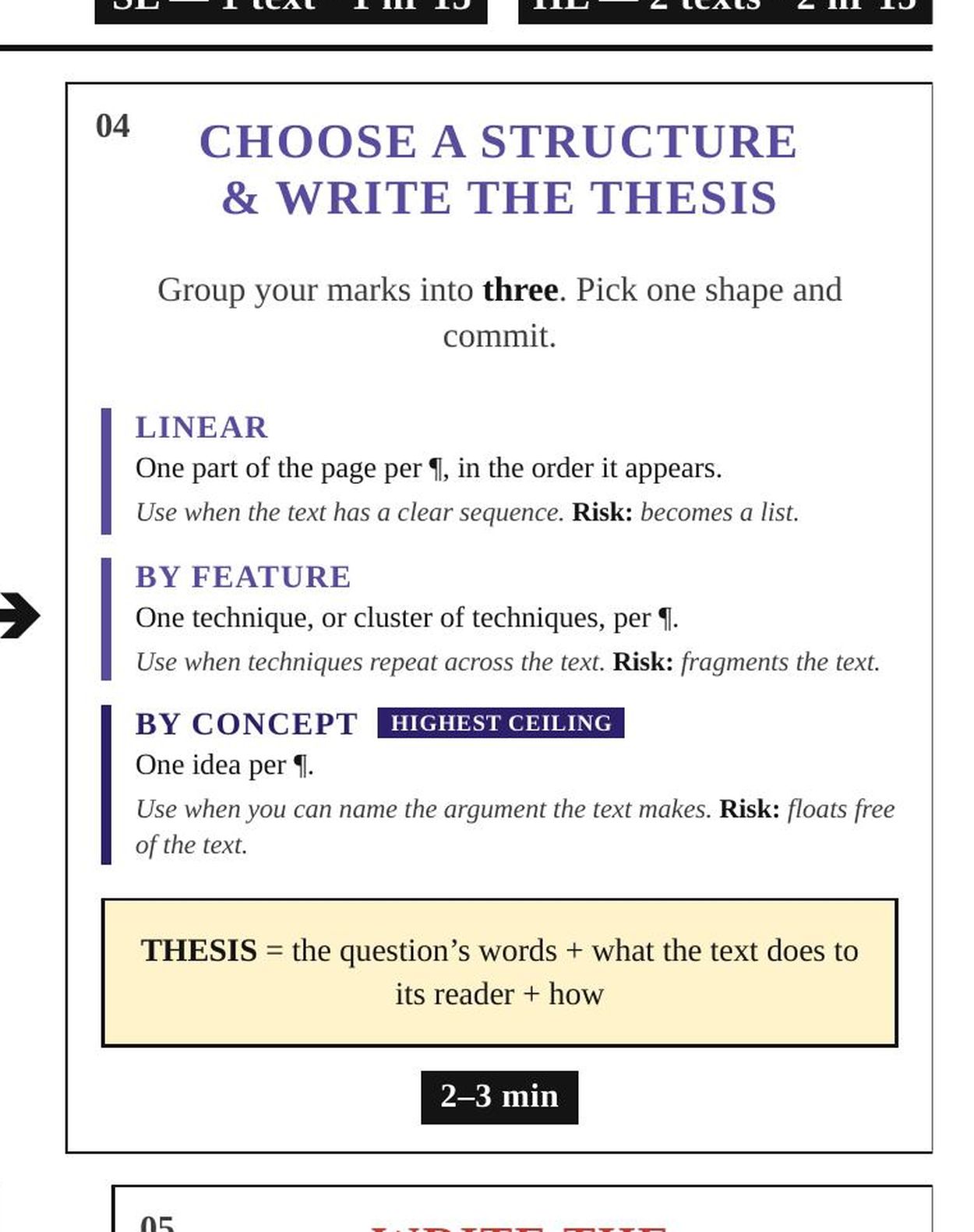
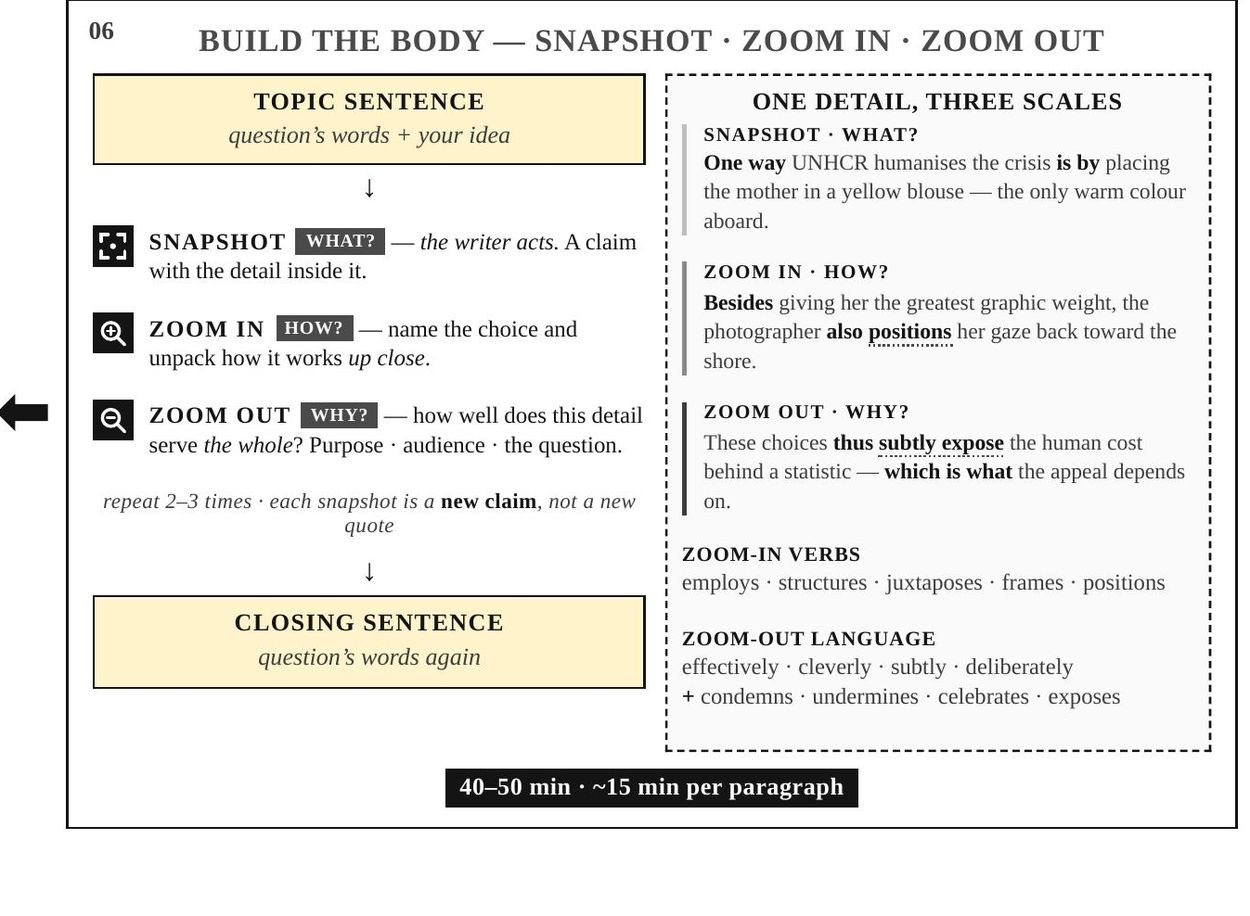
The full sheet, then four of its seven stations
The problem
Students rarely fail Paper 1 because they cannot analyze. They fail it because they spend twenty-five minutes annotating, panic at the halfway bell, and write two rushed paragraphs that list techniques. The knowledge is there. The clock beat them.
Most Paper 1 guidance makes this worse by describing what a good answer contains — a clear thesis, close analysis, an awareness of audience — without saying when any of it should happen. A student who already knows what a thesis is still does not know whether they should have written one by now.
What I changed
I stopped writing advice and started writing a schedule. Every station on this sheet carries a time budget, and the budgets add up to the paper: five minutes of reading time, two to three minutes on the question, nine to eleven annotating, forty to fifty writing the body, eight to ten to conclude and proofread. A student glancing up mid-exam can tell whether they are ahead or behind.
The sheet also runs in the shape of the exam rather than the shape of a document — left to right along the top, then back right to left along the bottom, with the black bands marking the three phases: reading time, writing time begins, paper has ended. It is a route, not a reference.
Two other decisions worth naming. The structure chooser gives three options and states the risk of each rather than pushing one: linear becomes a list, by feature fragments the text, by concept floats free of it. Students choose with the cost in view. And the body-building station works a single detail at three scales — a yellow blouse in a UNHCR photograph, at snapshot, zoom in and zoom out — with the connecting language supplied underneath, because the sentence that moves from how to why is the one language learners most often cannot start.
Each snapshot is a new claim, not a new quote. That one line resolves more Paper 1 body paragraphs than any amount of advice about analysis.
What's in it
- 01 · Mind the Gap — reading time has one job: genre, audience, purpose. SL guidance on choosing the text you can say most about, rather than the easiest-looking one
- 02 · Unpack the guiding question — circle two or three key words, then define the vague ones: an effect becomes which effect
- 03 · Annotate: See · Feel · Respond — three passes with a field of terms under each
- 04 · Choose a structure and write the thesis — linear, by feature, or by concept, each with its use and its risk, plus a thesis formula
- 05 · Write the introduction — four numbered moves, narrowing from text type to thesis
- 06 · Build the body — snapshot, zoom in, zoom out, with a worked example and two verb banks
- 07 · Conclude and proofread — including six alternatives to "in conclusion"
Who it's for
DP Language & Literature, SL and HL, and it carries the timings for both — SL one text in an hour and a quarter, HL two texts in two and a quarter. Most useful printed at A3 and put on the wall from the first term of Year 1, so the sequence is familiar long before it is needed under pressure.
It also works as a review sheet in the two weeks before the exam, and the See · Feel · Respond pass transfers to any visual text analysis, including Paper 1 practice on advertising and photojournalism.
If you want the visual vocabulary that sits underneath station 03, that's Image as Text.
Take it
Free One PDF · no signup · print at A3 or A4Print it, put it on the wall, hand it to a colleague. If you adapt the timings for your own cohort I'd be glad to hear what you changed.