The Collection / Theory of Knowledge
Theory of KnowledgeDiscovered, or Merely Agreed Upon?
Five lessons on mathematics as an area of knowledge, ending where students least expect: with a sand drawing made in Angola two thousand years before Euler, and the question of who gets credited with knowing something.
Five slides of five lessons
The problem
Mathematics is the area of knowledge students assume is settled. It is where right answers live. Tell a class that mathematical certainty rests on chosen assumptions and they will agree politely, because agreeing costs nothing — and then carry on believing that two plus two equals four in a way that nothing else is true.
Arguing them out of it doesn't work either. What works is showing them a question they are certain about, and then making their certainty fail in front of them.
What I changed
The unit is built out of demonstrations rather than claims, and the sequence matters.
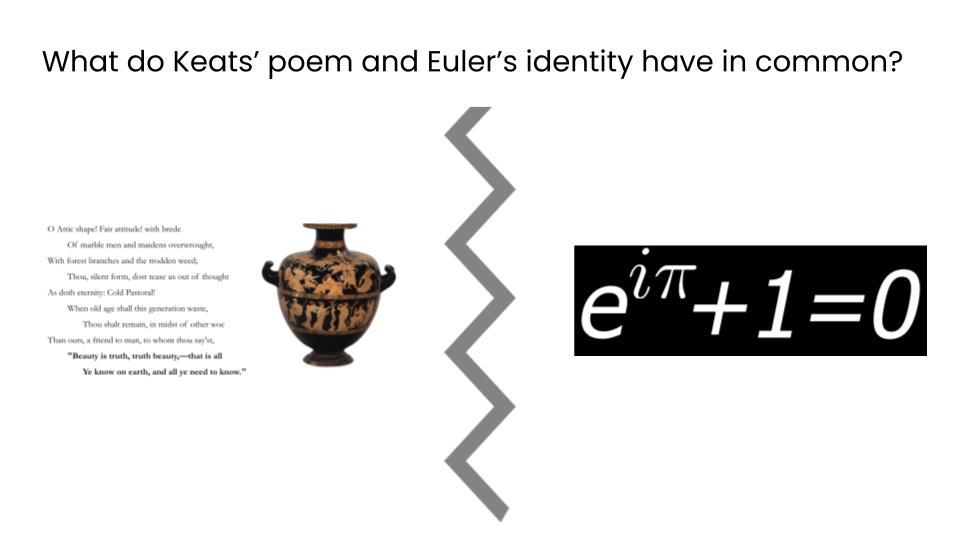
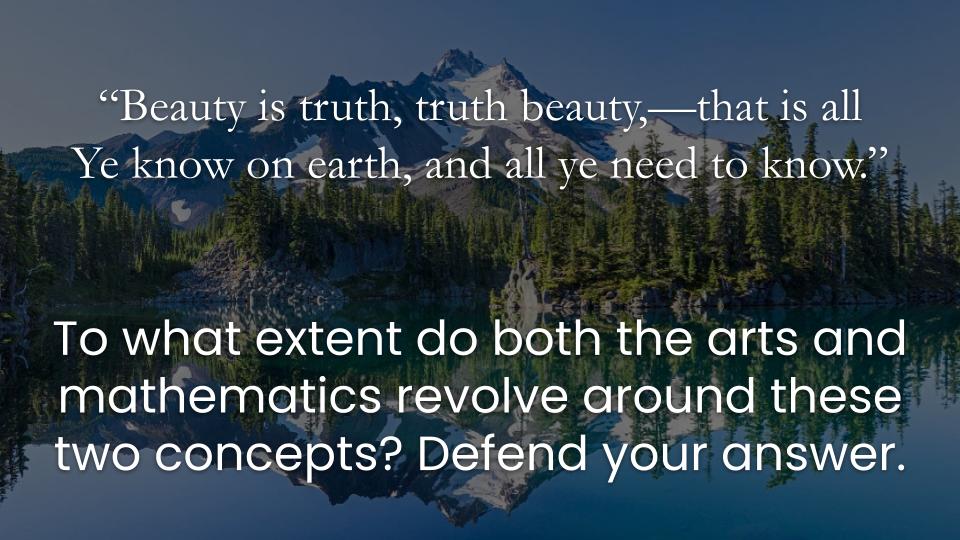
It opens on the left-brain–right-brain myth, which students believe and which is false, and asks why a debunked idea survives. That sets up mathematics and the arts as supposed opposites — and then reads Ode on a Grecian Urn against it, ending on beauty is truth, truth beauty. Students who arrive certain that math and poetry have nothing to do with each other spend the first lesson losing that.
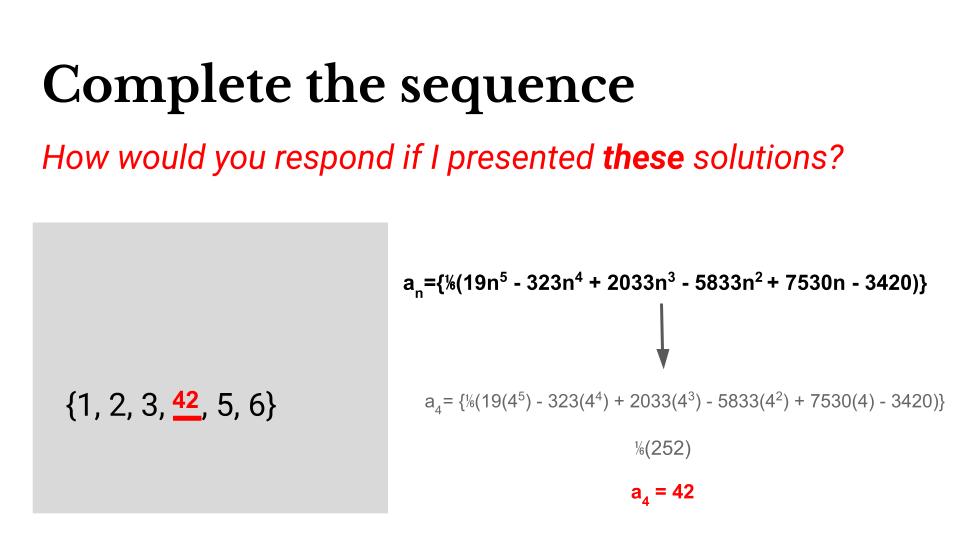
Lesson two is the load-bearing one. A distance between two places produces two different correct answers, depending on assumptions nobody stated. Then sequence completion: everyone confidently fills in 1, 2, 3, __, 5, 6 — and is shown a fifth-degree polynomial under which the answer is 42. Not a trick. A valid formula, worked on the slide.
Sequence completion relies on pattern guessing, whereas mathematical certainty is derived deductively from explicit axioms. In formal mathematics, without explicit starting rules, is 42 any less valid than 4?
That is the moment the abstract claim becomes a felt one. Students have just been wrong, together, with complete confidence, about something they thought could not have two answers.
Lesson three is a play
Students read a mathematical dialogue aloud in parts — Teacher, Alpha, Beta, Gamma, Delta, Phi — in which a proof is proposed and then argued to pieces by counterexample after counterexample. It is Lakatos's method, and staging it as a play rather than assigning it as reading changes what students take from it: they hear mathematics being done, with disagreement, backtracking and repair, instead of arriving finished.
The setup is the interior angles of a triangle and why the familiar paper-tearing demonstration, however useful in a classroom, is not a proof. Students who have been shown that demonstration for years have to work out why it was never the thing they thought it was.
Then it widens
The last lesson starts with a map-coloring problem and a puzzle about rooms and doors, neither of which looks mathematical, and both of which are graph theory. Euler gets his credit for founding the field in eighteenth-century Europe.
And then the sona sand drawings of the Lunda-Tchokwe people of eastern Angola arrive — continuous, closed curves traced in sand under exactly the constraints Euler formalized, in a tradition roughly two thousand years old. Alongside them, sandroing in Vanuatu, and Marcia Ascher's founding work in ethnomathematics, which had to argue against the assumption that only literate societies could do mathematics at all.
The unit ends on a question students cannot answer quickly:
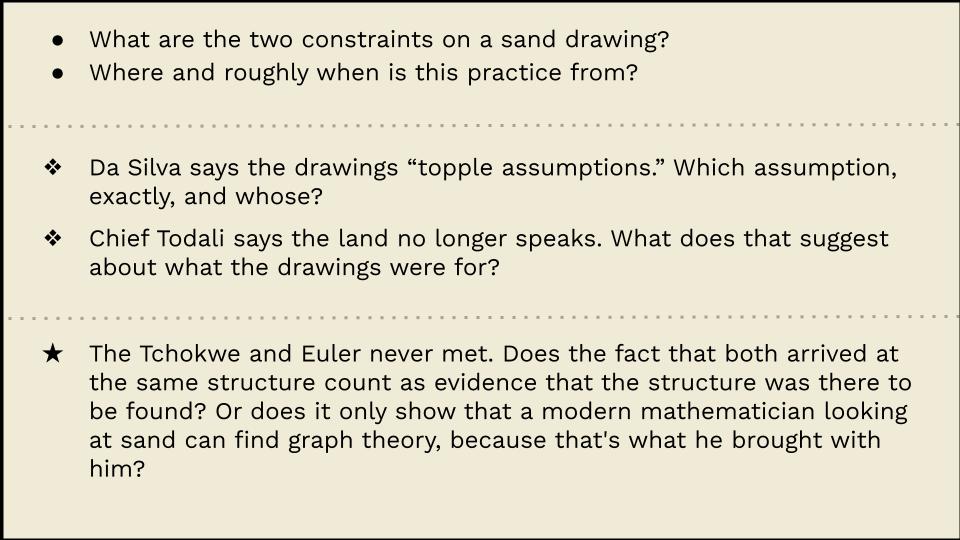
Tchokwe and Euler never met. Does the fact that both arrived at the same structure count as evidence that the structure was there to be found? Or does it only show that a modern mathematician looking at sand can find graph theory, because that is what he brought with him?
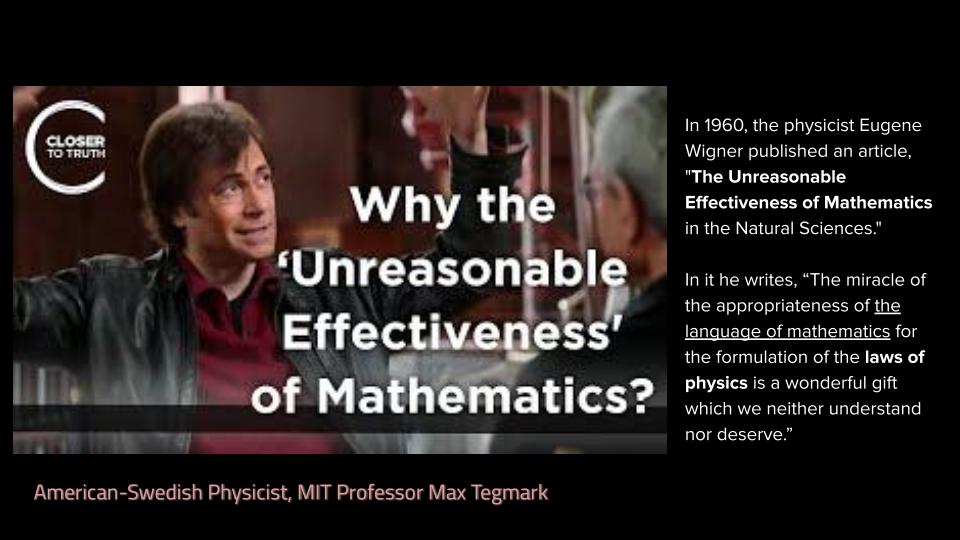
Either answer costs something. If the structure was there to be found, mathematics is discovered and the conventions of lesson two are a surface over something real. If it was brought, then what we call mathematical knowledge depends on who is doing the looking — and the credit given to Euler and withheld from the Tchokwe stops being an oversight and becomes a demonstration of the point.
What's in it
- Lesson 1 — Mathematics and the arts · the neuro-myth as a way in, truth and beauty, Keats read in a math lesson
- Lesson 2 — Proof or consensus · the two-answer distance problem, non-Euclidean geometries, the sequence demonstrations with full working, perfect numbers, competing methods for the same quadratic, and al-Khwārizmī on what counted as a valid solution
- Lesson 3 — The play · the triangle demonstration, the dialogue in parts, and a written response referencing it
- Lesson 4 — Argumentative response · a prompt on whether arbitrary conventions rule out mathematical discovery, with a four-band rubric
- Lesson 5 — Graph theory and ethnomathematics · map coloring, the rooms-and-doors puzzle, Euler, sona, Vanuatu sandroing, and fractal African settlements
- Tiered question sets · three tiers for the sona reading and the fractals film — comprehension, inference, then the arguments the unit exists for
Who it's for
DP Year 1 Theory of Knowledge, as the Mathematics area of knowledge. Five lessons, and the sequence is load-bearing — lesson five lands very differently if students have not already watched their own certainty fail in lesson two.
No mathematical background is needed to teach it. The heaviest thing on the board is a polynomial you read out rather than derive, and the point of it is that it works, not how.
The discovery-or-invention question runs again in the Arts in Four Clips, One Voice, where a producer either finds something in a singer's performance or puts it there. Running both lets students meet one problem in two areas of knowledge. The timed essay in Two Answers to the Same Question assesses across exactly that pair, and its exemplars draw on this unit's content.
Acquire
$10 One teacher · five lessons · copies to your own DriveDelivered as Google Slides and Docs that copy into your own Drive, editable — cut the Keats, swap the case studies, keep the sequence. A Google account is required. Department licenses available for whole-team use; reply to the checkout email and I'll sort it.
Take it from the shelf