The Collection / Theory of Knowledge
Theory of KnowledgeTwo Answers to the Same Question
A timed essay scaffold for mathematics and the arts, with a weak response and a strong one written to the same prompt on the same six boxes — so students can see that the difference is not what you know.
Five pages of twelve
The problem
Ask a class why one TOK essay scored higher than another and they will tell you the good one had better examples. It is the most durable misconception in the subject, and it sends students hunting for impressive-sounding content — quantum mechanics, Gödel, something with a name they can drop — instead of doing more with what they already have.
Under timed conditions the problem sharpens. A student with forty minutes and no structure produces a paragraph that announces a subject rather than taking a position, names an example without testing anything against it, and then hedges: however, this is a complicated issue. Every one of those is a recognizable move, and none of them is a knowledge question.
What I changed
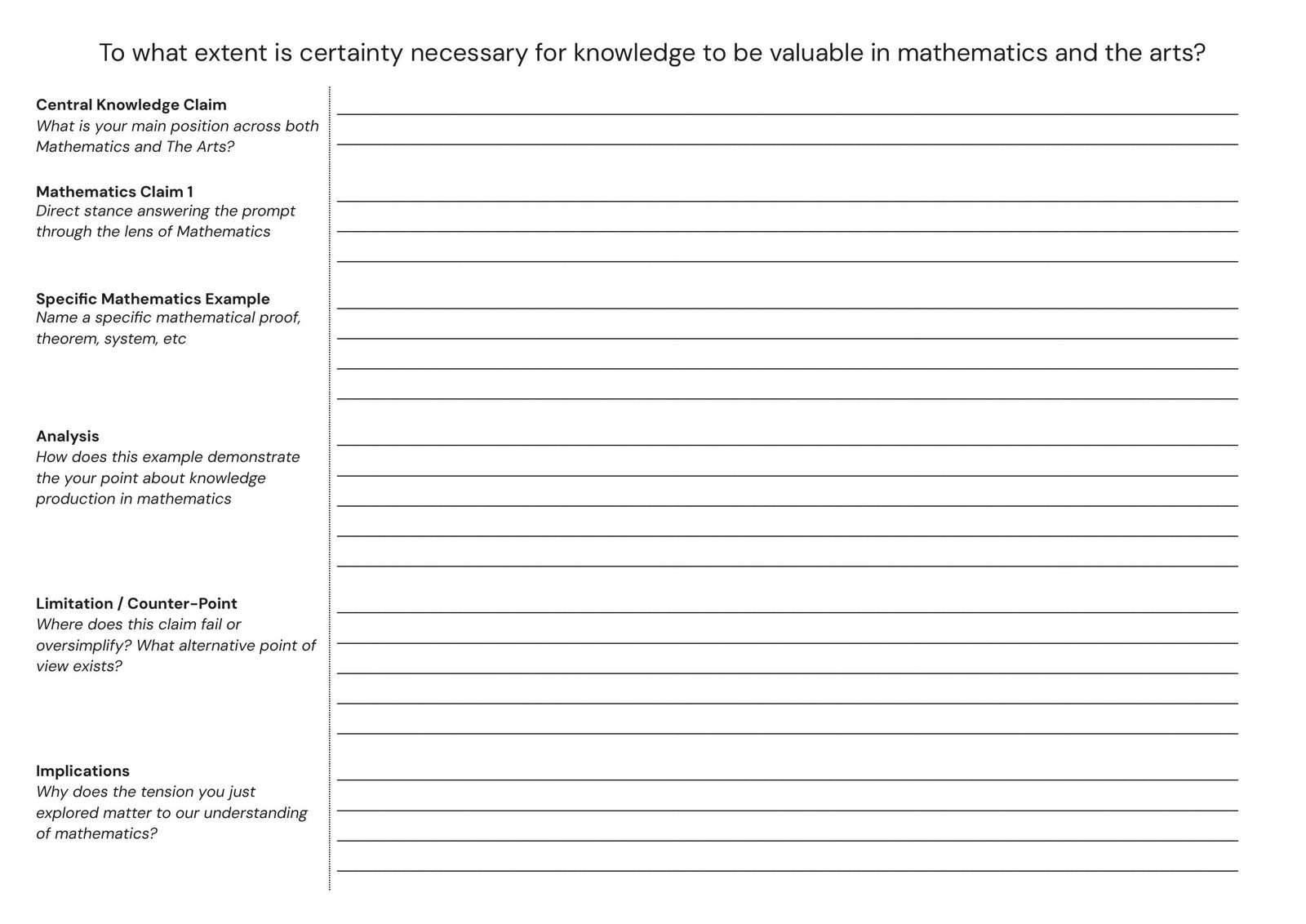
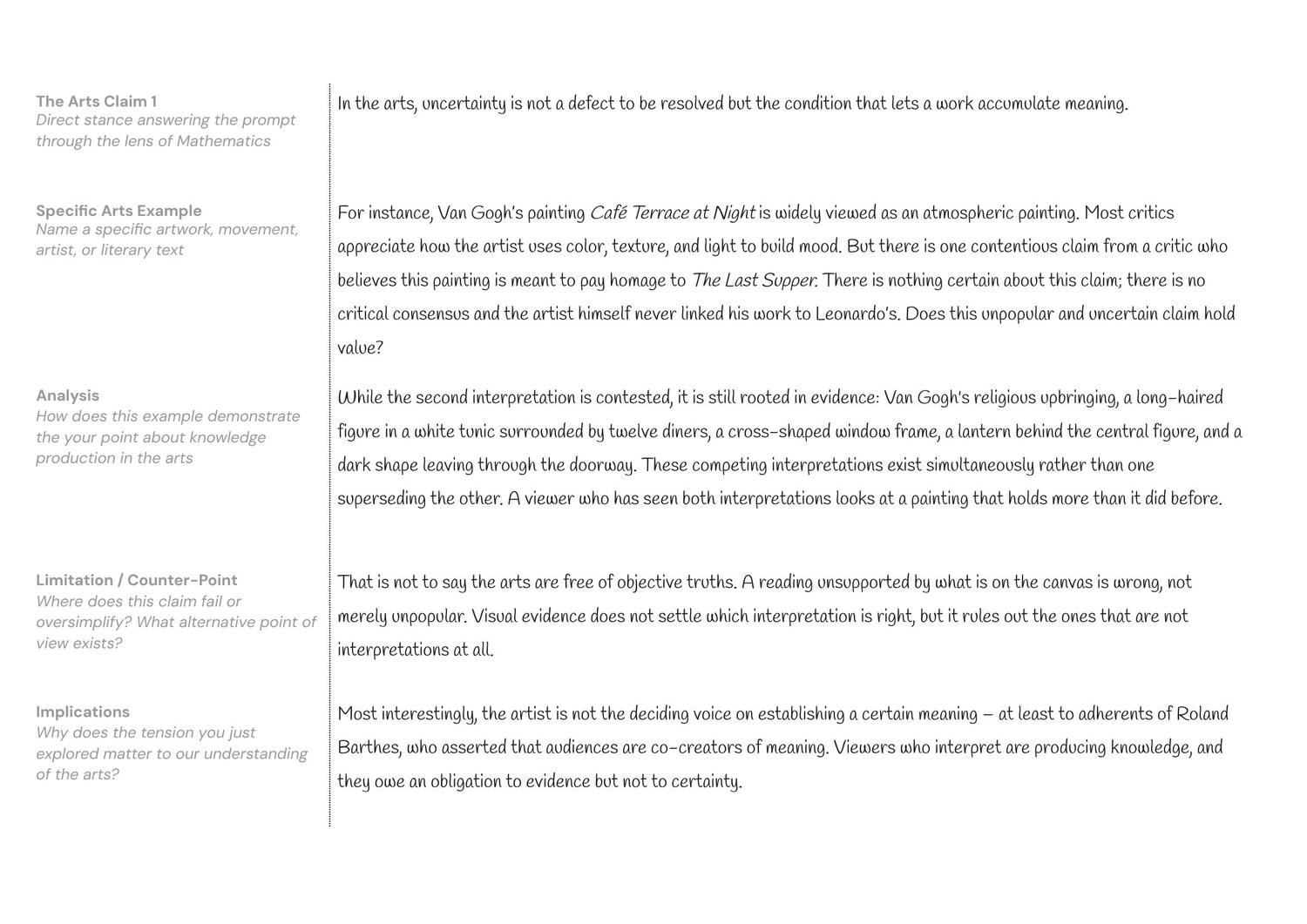
Two things. First, a fixed architecture — six named boxes, run once through mathematics and once through the arts: central knowledge claim, claim, specific example, analysis, limitation, implications. Naming the boxes means a student can see that they have written an example and then stopped, rather than sensing vaguely that something is missing.
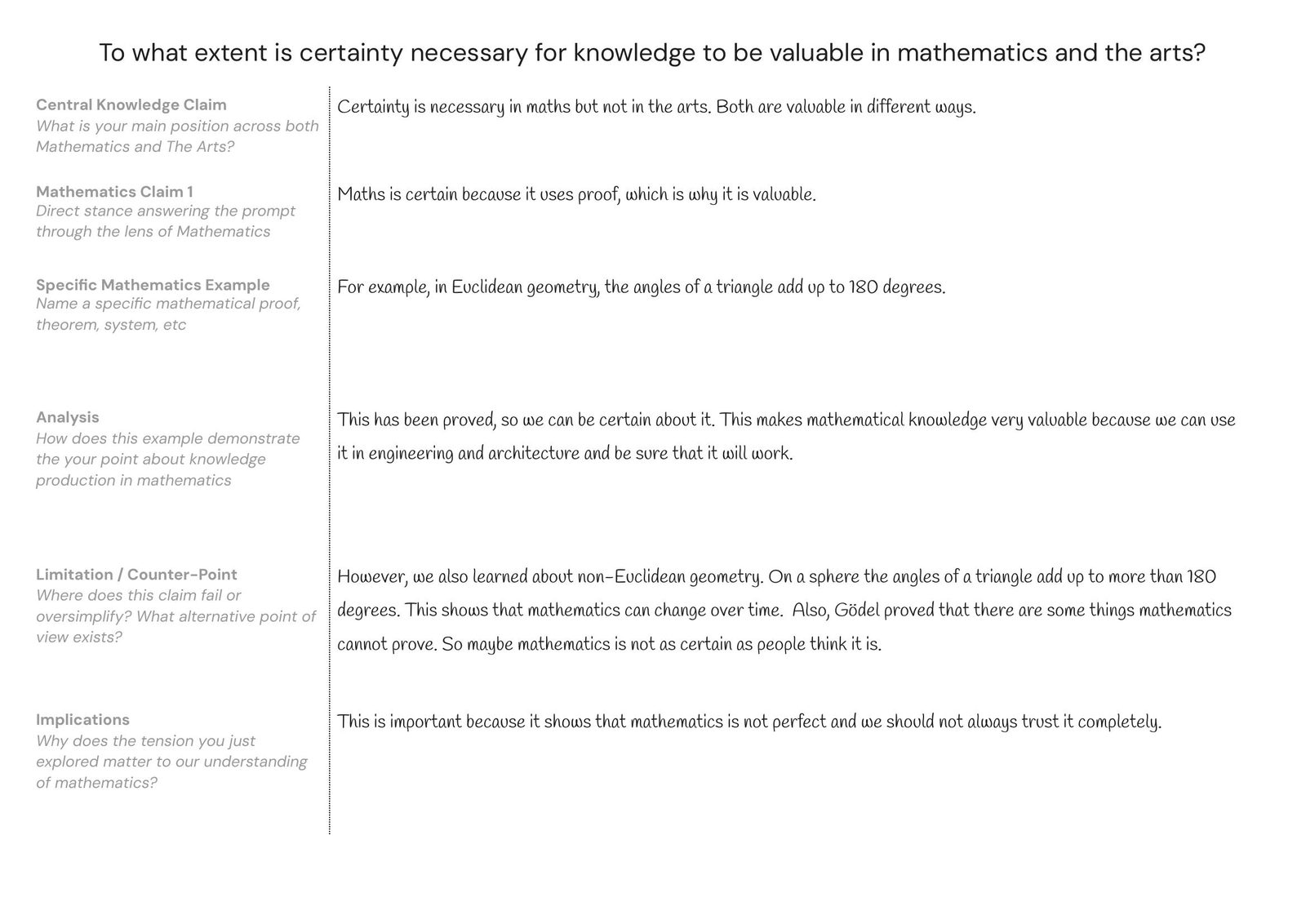
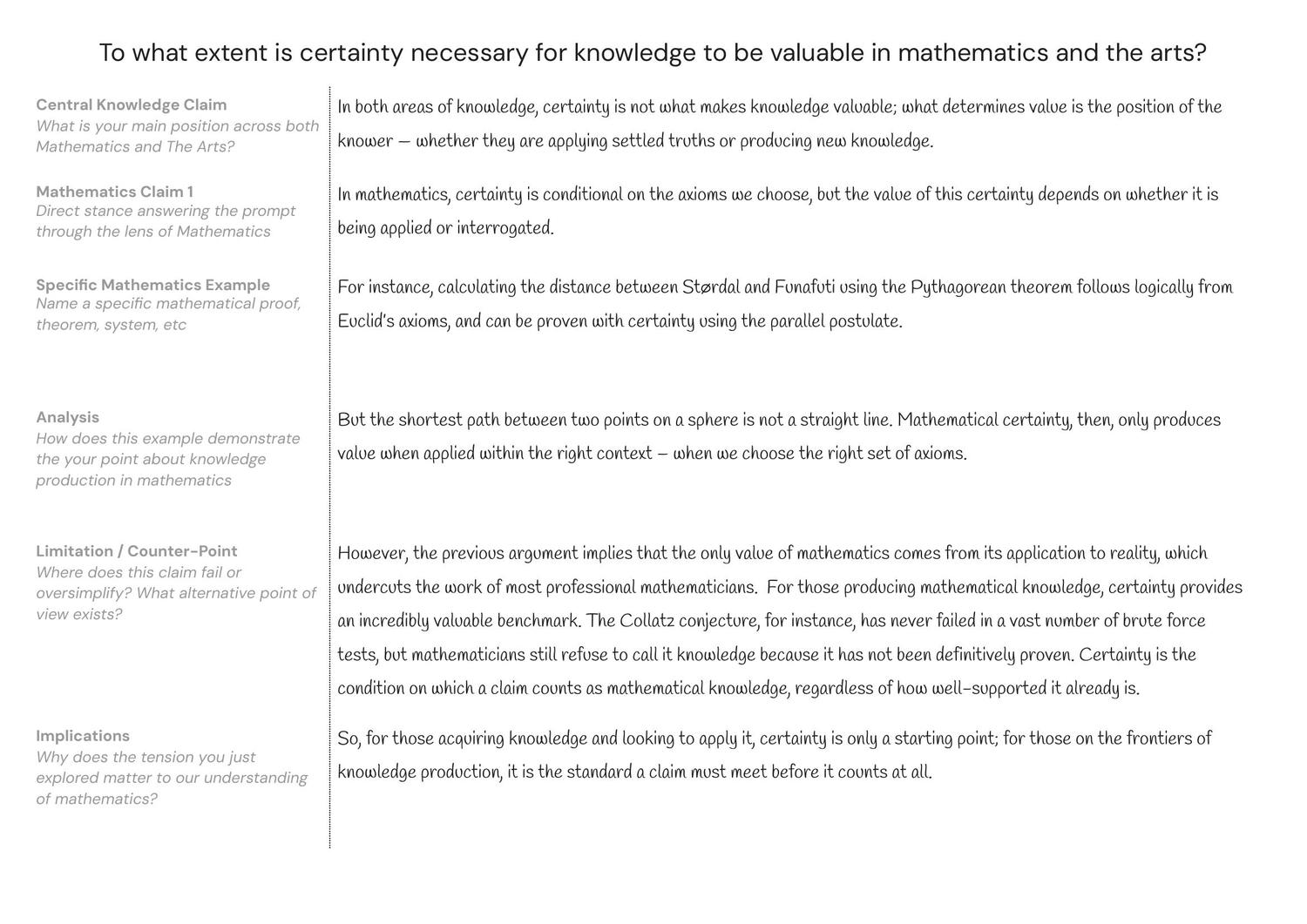
Second, and this is the part that does the work: the two exemplars answer the same prompt using the same unit content. Both draw on the material of the mathematics unit — non-Euclidean geometry, Gödel, Collatz, the ranking of Mount Fuji images. Neither student knows more than the other. So when the strong response lands and the basic one doesn't, the difference is visibly located in what was done with the material, and the usual objection dies before it is raised.
You can put the two side by side, box by box, and ask what changed. In the limitation box, the basic response offers some people say critics and experts decide. The strong one raises an objection that genuinely restricts its own claim, then narrows the claim to survive it. Same box, same prompt, entirely different move.
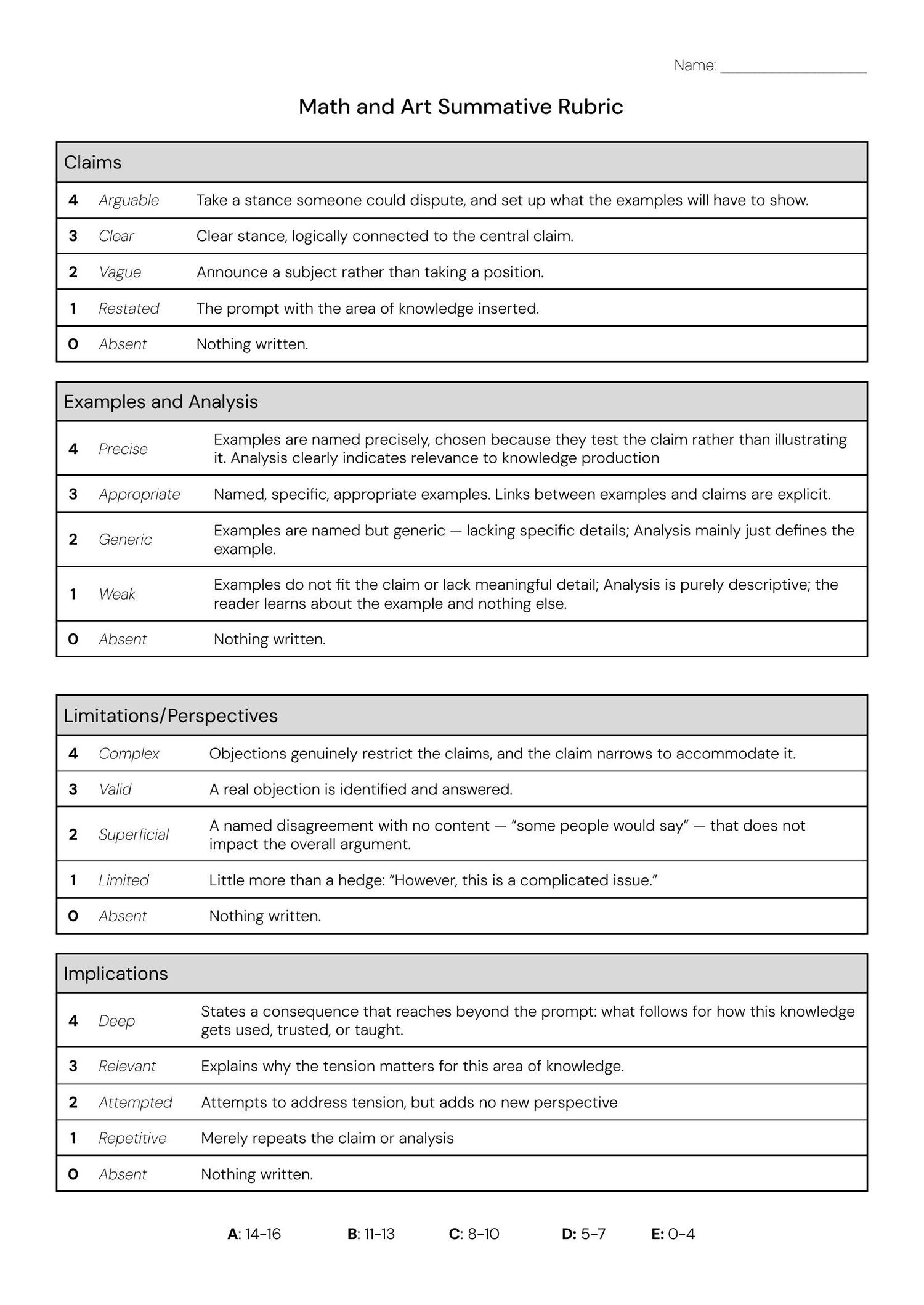
The rubric names failure modes rather than describing quality: Vague, Generic, Superficial, Repetitive. Students recognize their own writing in the band descriptors, which is uncomfortable and useful.
What's in it
- Practice prompt with paired exemplars — "To what extent is certainty necessary for knowledge to be valuable in mathematics and the arts?" Blank template first, then a basic response, then a strong one, all on the same six boxes
- Summative prompt — "To what extent do you agree that both mathematics and art are primarily motivated by the search for truth?" Same architecture, new question, so the structure has to transfer rather than be recalled
- Rubric — four criteria at five bands: claims, examples and analysis, limitations and perspectives, implications. Sixteen points, with grade boundaries
Who it's for
Written for DP Year 1 Theory of Knowledge as timed essay preparation, and it assumes students have met some mathematics and arts content already — the exemplars lean on a unit covering non-Euclidean geometry, Gödel and Collatz. Swap in your own examples and the structure holds.
The six-box scaffold also works as a planning frame for the full TOK essay, and the rubric transfers to any prompt that asks students to work across two areas of knowledge.
It pairs directly with Discovered, or Merely Agreed Upon?, which supplies the mathematics content the exemplars draw on.
Take it
Free Three PDFs · no signup · print and goUse it, adapt it, hand it to a colleague. If it's useful I'd like to know what you changed — that's the part I learn from.