The Collection / Theory of Knowledge
Theory of KnowledgeFour Clips, One Voice
One vocal performance, four media, and a song about panicking in a club that became a track people dance to in clubs. Two lessons on how the medium changes what a work can mean.
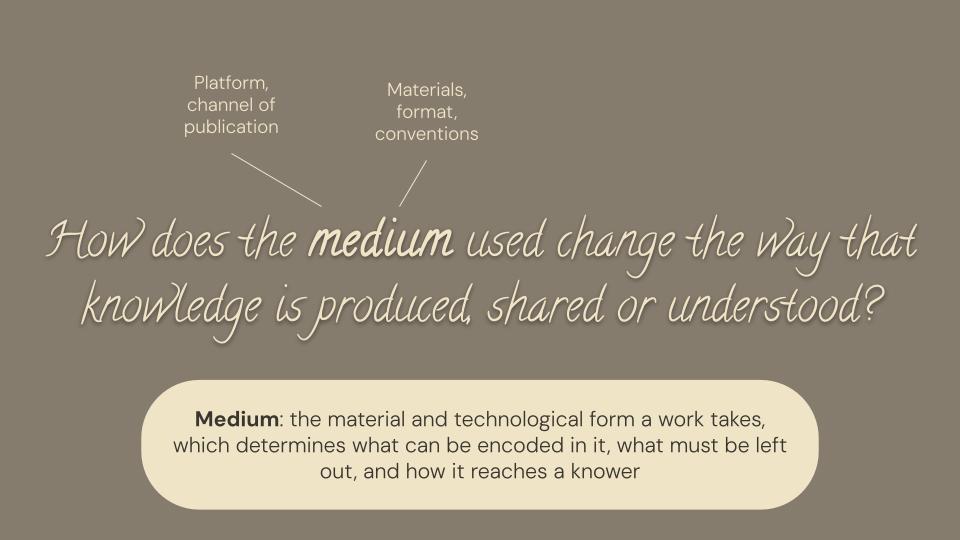
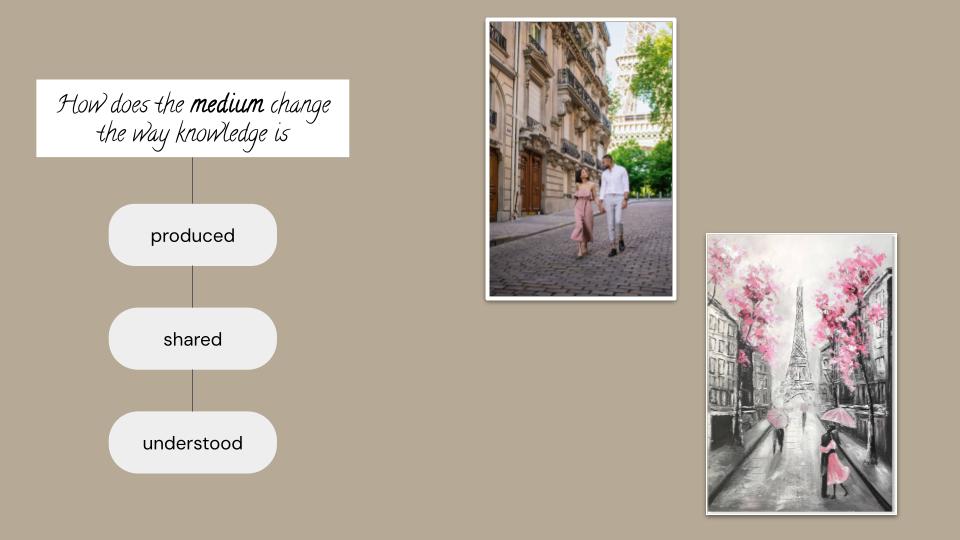
Five slides of fifteen
The problem
"How does the medium change the way knowledge is produced, shared or understood?" is an official knowledge question, and students answer it with the book-versus-film comparison they have been making since Grade 7. The film leaves things out. The book lets you imagine it yourself. True, tired, and not an argument.
The trouble is that the usual examples are too far apart. A novel and its adaptation differ in so many ways at once — different makers, decades apart, different budgets and intentions — that the medium cannot be isolated as the variable. Whatever changed, you cannot prove the form did it.
What I changed
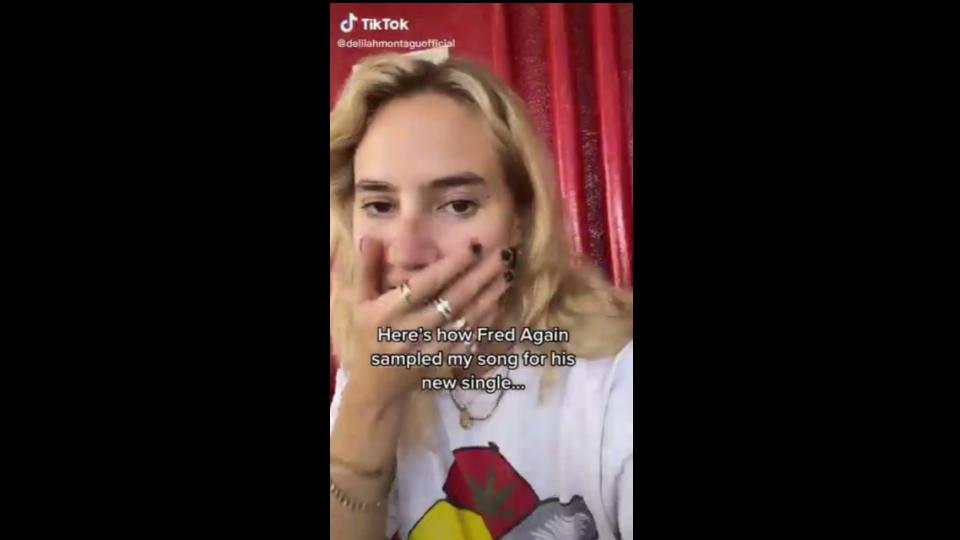
The case study holds the content almost perfectly still. One vocal performance, four media. The same voice appears in a produced music video, in a DJ set in front of a crowd, in a phone-shot reaction filmed in a bedroom, and in a stripped-back live performance in a record shop. Same singer, same words, roughly the same cultural moment. The only thing that really moves is the form and the room.
And the meaning does not merely shift — it inverts. Delilah wrote the song about feeling anxious in a club. Fred's version is what people dance to in loud clubs. A student can no longer argue that medium is a neutral container for content, because the container turned the content inside out.
The warm-ups come first and stay brief — the same content in two forms, three times over — then the case study earns the rest of the two lessons.
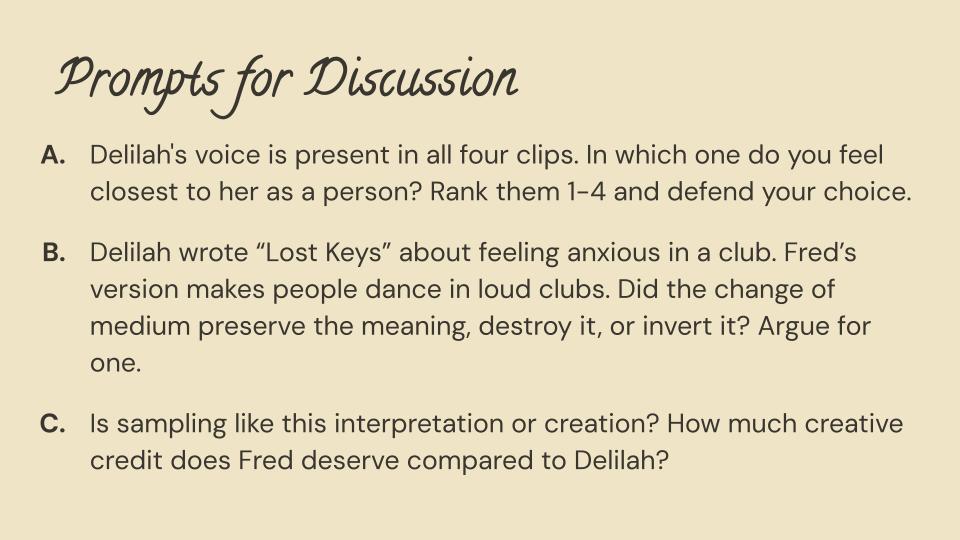
Delilah's voice is present in all four clips. In which one do you feel closest to her as a person? Rank them one to four and defend your choice.
That prompt does more than it looks like. Students rank confidently and then discover the class disagrees, and the disagreement is never about the words — it is about production, intimacy, volume, and what a phone camera does that a studio cannot. They have started analyzing medium before anyone has told them to.
The assessment forks deliberately
Students answer two questions, one from each pair, and the pairs work at different altitudes.
The first pair is about this work. Did slowing the video down reveal something already in her performance, or create something that wasn't there? And: the artist says her song became something else and seems glad about it — does her own account settle what it now means, or is she now one knower among many?
The second pair is about the area of knowledge, and it splits along the official question of whether the arts are a system of knowledge or an experience. Take the system branch and you argue from technique and convention across the four versions. Take the experience branch and you argue that each medium generates knowledge that the others cannot. A student has to commit to one, which is harder and more useful than describing both.
Concrete first, abstract second. Students who cannot yet theorize about an area of knowledge can still argue hard about whether Fred found something or made it.
Discovered or created, again
That first question is deliberately the same question as Discovered, or Merely Agreed Upon? asks about mathematics. Run both and students meet the discovery-versus-invention problem in two areas of knowledge that could not look less alike — a sampled vocal and a mathematical proof — and start noticing it is one problem wearing two costumes.
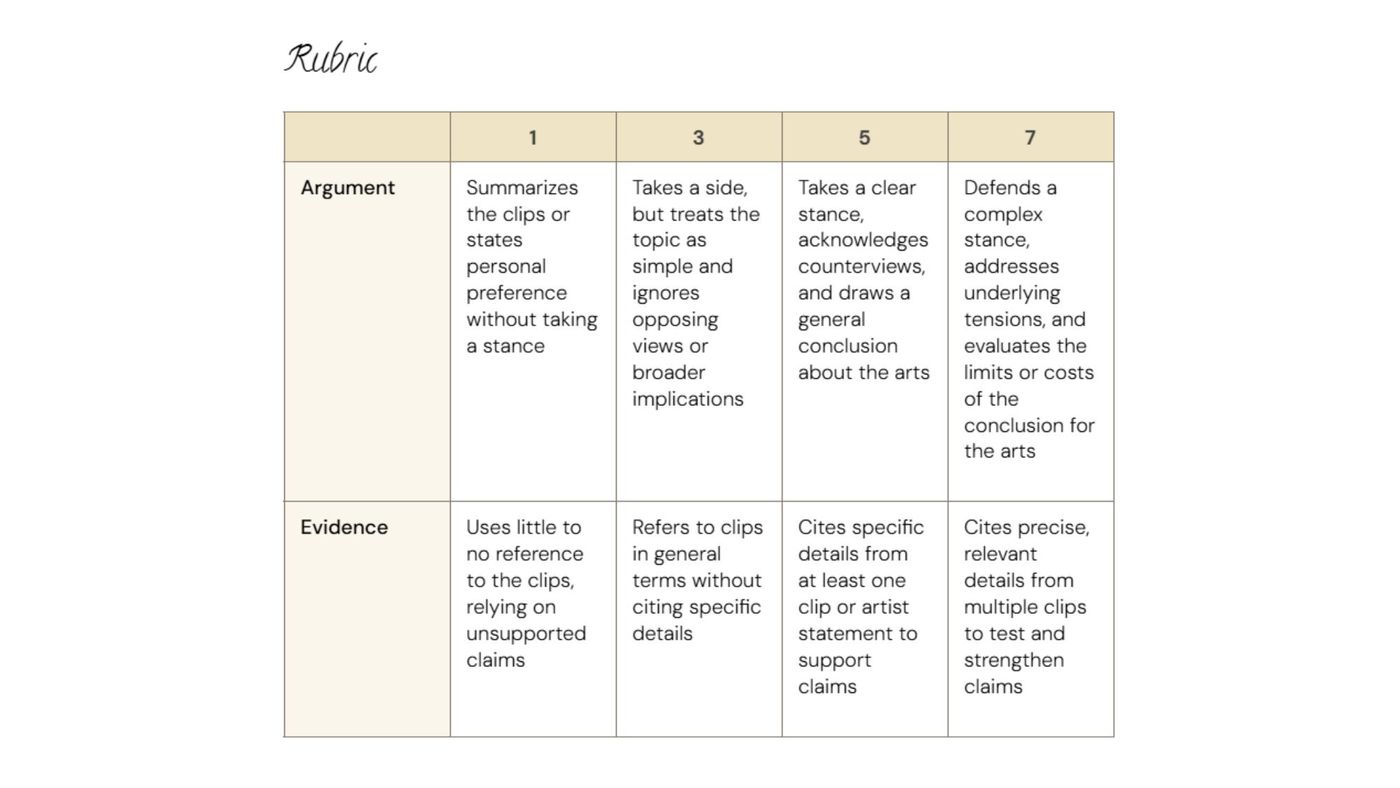
The rubric is two rows and four bands. Its top band is the one worth reading: a band 7 argument evaluates the limits or costs of the conclusion for the arts. Not a stronger claim — a claim that knows what it gives up.
What's in it
- The deck — fifteen slides: the central question with a usable definition of medium, three quick warm-up comparisons, the four clips embedded in sequence, three discussion prompts, and the assessment questions
- The argumentative response — four questions in two pairs, students answer one from each, with the full rubric
- The rubric — argument and evidence, bands 1, 3, 5 and 7
The clips are embedded as links to material that is publicly available, so nothing here depends on files that might disappear from your Drive.
Who it's for
DP Year 1 Theory of Knowledge, in the Arts as an area of knowledge. Two lessons, and it works as an opener for the AOK or as a standalone on knowledge and technology.
The case study will age, and that is fine — the structure is what matters. Any artist, any sample, any performance that exists in several media will run the same two lessons. What you want is a work where the meaning visibly changed, not merely the packaging.
Students meeting Dewey on art as experience and Danto on the artworld will find both in Pillars of Western Thought, mapped to the same official questions this assessment forks on.
Take it
Free Deck and assessment · copies to your own DriveBoth files copy into your own Drive, editable — swap the artist when this one dates, keep the structure. If you find a better case study I'd like to hear about it.