The Collection / Theory of Knowledge
Theory of KnowledgePillars of Western Thought
Forty-two thinkers, eighty-four verified quotations, and a guide to the Western canon that keeps interrupting itself with the voices that dismantle it.
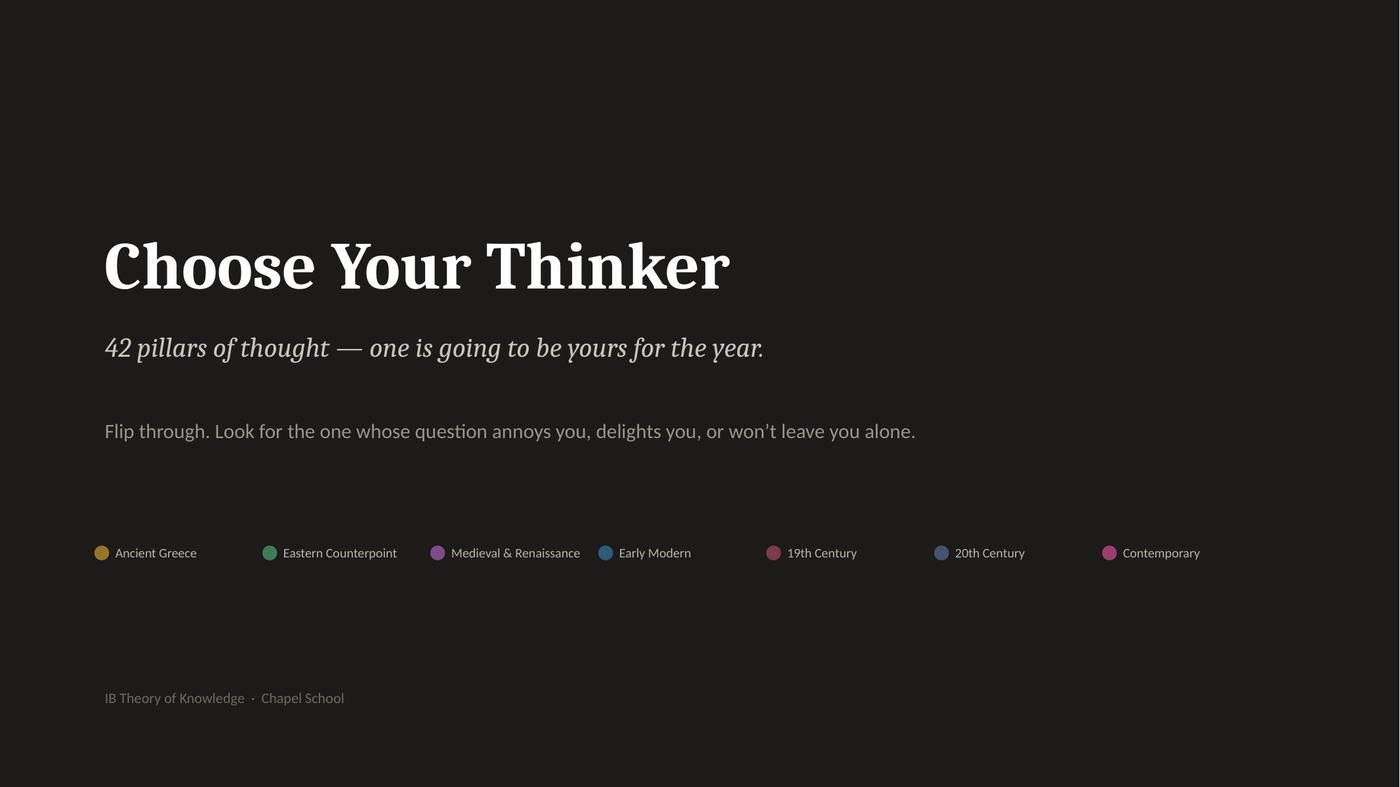
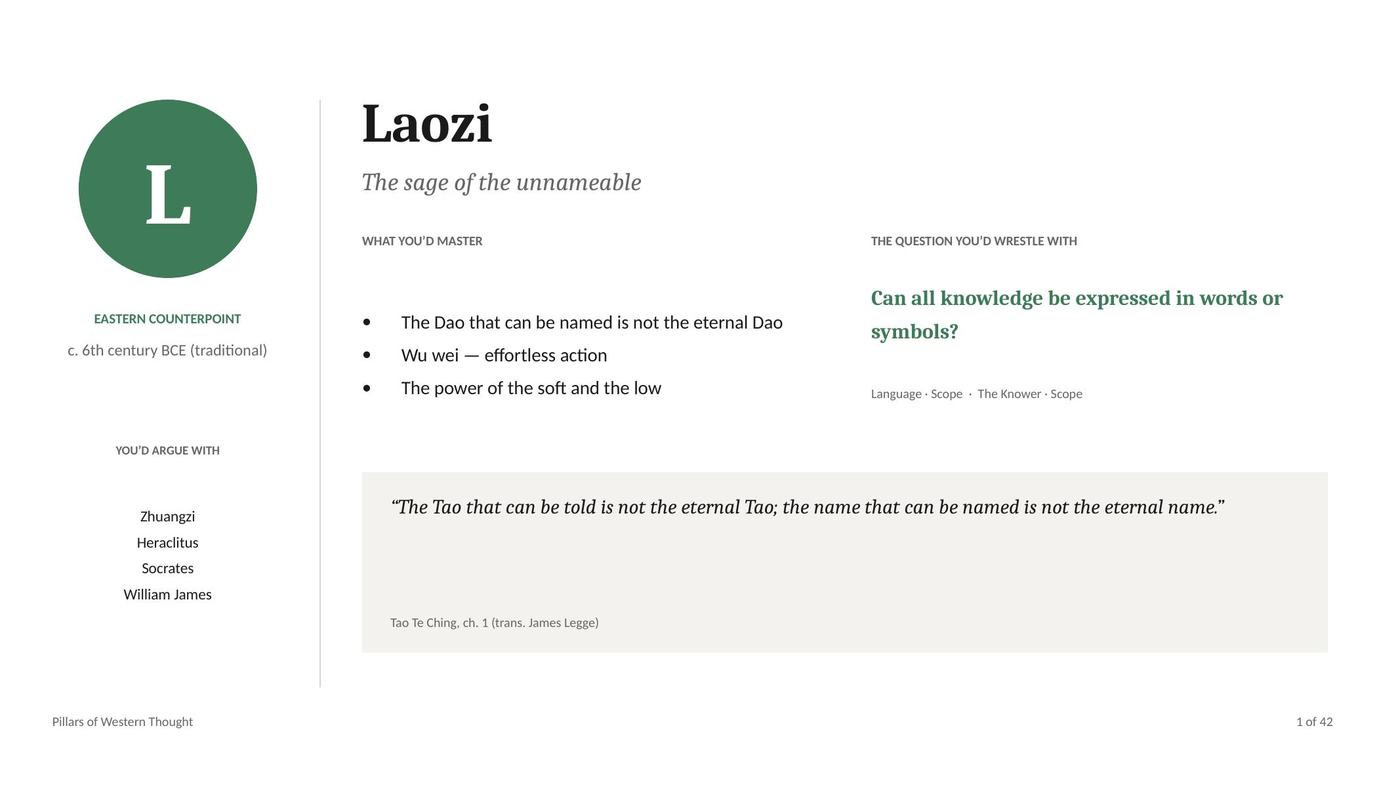
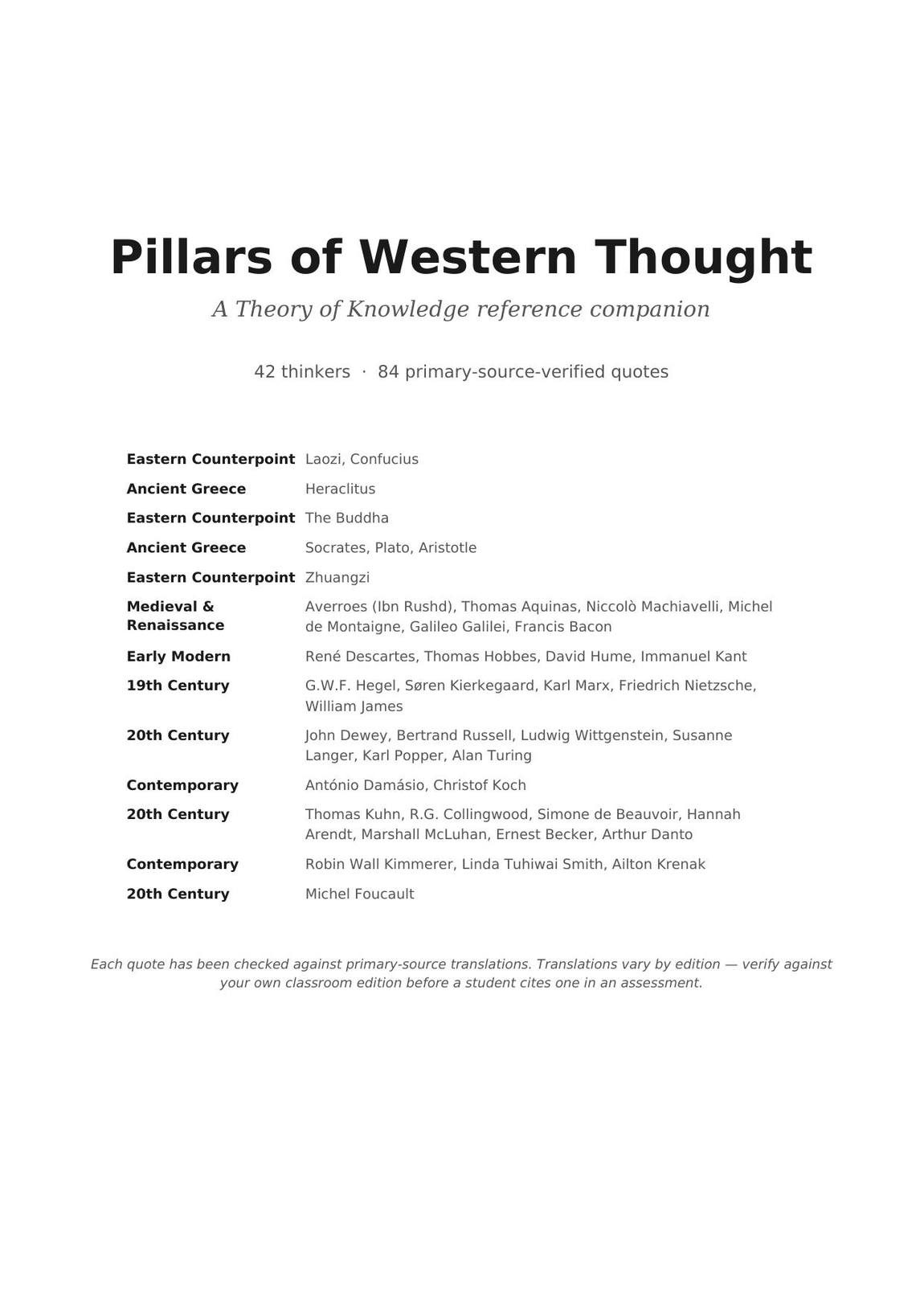
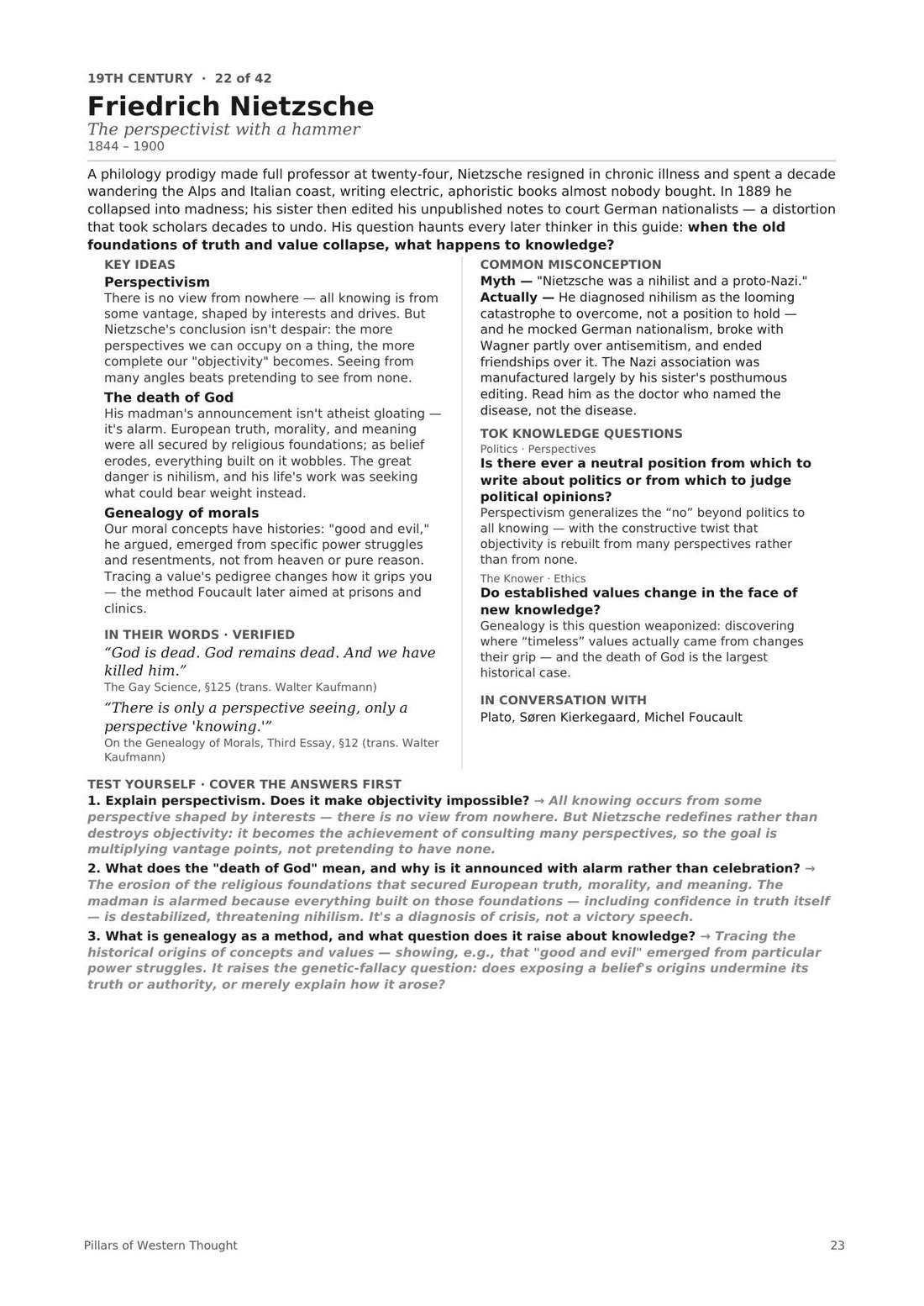
Five views of forty-two profiles
The problem
TOK students quote philosophers constantly and understand them rarely. The quotations arrive from the internet, unsourced and often misattributed; the ideas arrive as slogans. Nietzsche was a nihilist. Machiavelli was evil. Kant said reality is all in your head. Kuhn proved science is just fashion. Every one of those is wrong, and every one of them turns up in essays.
The deeper problem is what a canon does when you present it as a list. A student handed forty-two Western thinkers in chronological order learns, without being told, that this is what thinking looks like and that it happened in Europe.
What I changed
The guide is called Pillars of Western Thought and then spends its length undercutting the title. Eastern counterpoints are not appended at the end — they are cut into the sequence at the exact points where they bite. Laozi arrives immediately before Socrates, so that the Daodejing's opening refusal to define anything lands against Socrates' demand for definitions. The Buddha's anattā sits in the same guide as Descartes' cogito, two inward experiments reaching opposite conclusions. Zhuangzi poses the dream problem nineteen centuries before Descartes and draws the opposite moral from it.
The same logic runs to the end: Averroes appears as the route by which Aristotle actually reached Aquinas, and the contemporary section closes with Kimmerer, Tuhiwai Smith and Krenak — three thinkers who ask who gets to count as a knower at all. A student reading the whole guide arrives at the conclusion themselves.
Every profile carries a Common Misconception section, because the misconception is usually what the student already believes. And every profile maps to the official IB knowledge questions, labeled by theme and element, so a thinker isn't just interesting — they are usable in an exhibition or an essay next week.
The quotations are checked against primary-source translations, with chapter and edition given. Eighty-four of them. The guide also says plainly that translations vary and should be verified against your own classroom edition before a student cites one, which is itself a small TOK lesson.
The deck is the seminar
The PowerPoint turns the reference guide into an assignment. Each thinker becomes a character sheet: what you'd master, the question you'd wrestle with, and — the mechanic that makes it work — who you'd argue with.
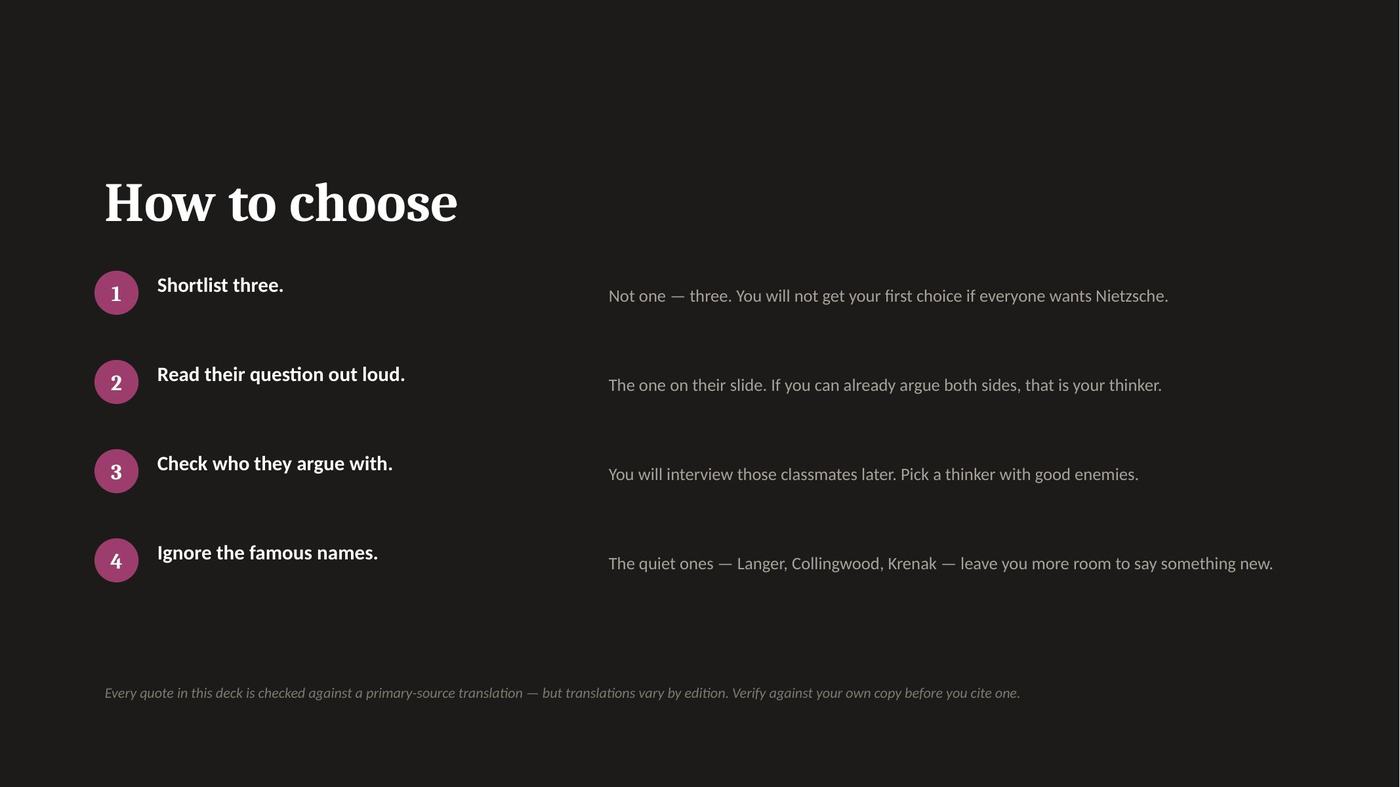
That last field is the seminar's seating plan hiding in plain sight. Students who pick Foucault will find Nietzsche, Hegel, Socrates and Arendt listed as their interlocutors, and those are the classmates they will face later. The closing slide tells them to choose accordingly: pick a thinker with good enemies. It also tells them to shortlist three, because they will not get Nietzsche, and to consider the quiet names — Langer, Collingwood, Krenak — precisely because there is more room to say something new.
Read their question out loud. If you can already argue both sides, that is your thinker.
What's in it
- The web version — the full companion as a single HTML file. No install, no account, works offline once saved; hand students the file or put it on your LMS
- The PDF — 43 pages, one thinker per page, print-ready as a class set or a reference shelf copy
- Choose Your Thinker — 46 slides for running the assignment, from the full field at a glance through all 42 character sheets to the how-to-choose closer
Each profile contains a biography written to be read rather than skimmed, three or four key ideas, two verified quotations with sources, the common misconception, two official TOK knowledge questions with a note on why that thinker answers them, a list of who they're in conversation with, and three self-test questions with the answers below the fold.
Who it's for
DP Year 1 Theory of Knowledge, as a year-long reference and as the spine of a Socratic seminar. It also works as an exhibition resource — the knowledge questions on each profile are the official ones, so a student who owns a thinker has a route into an object and a prompt.
Teachers of Philosophy, History and Literature will find it useful as a quick, accurate reference; the misconception sections are worth reading even if you never assign it.
If you're running the seminar, it pairs naturally with the discussion structure in History as an Unnatural Act, which includes an outer circle tracker for the students who aren't speaking.
Take it
Free Three formats · no signup · use whichever suits the roomSave the web version and it works offline. The deck is editable, so cut the thinkers you don't teach and add the ones I've missed — I'd genuinely like to know who those are.