The Collection / Language & Literature
Language & LiteraturePersepolis Through Four Lenses
Four groups read the same graphic novel four incompatible ways, then meet. Every student becomes the only person at the table who read the book their way — which is what finally makes literary theory matter to a sixteen-year-old.
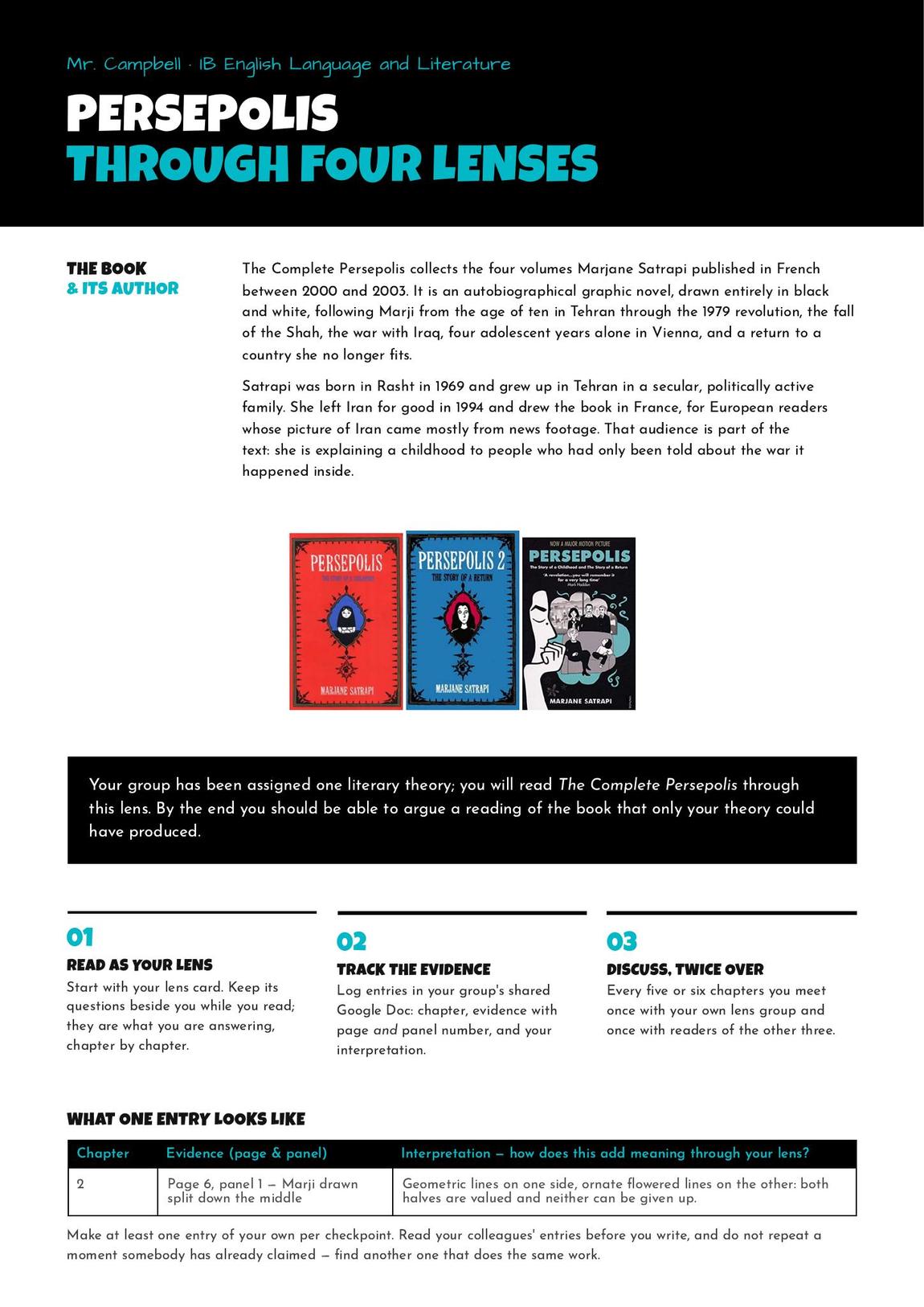
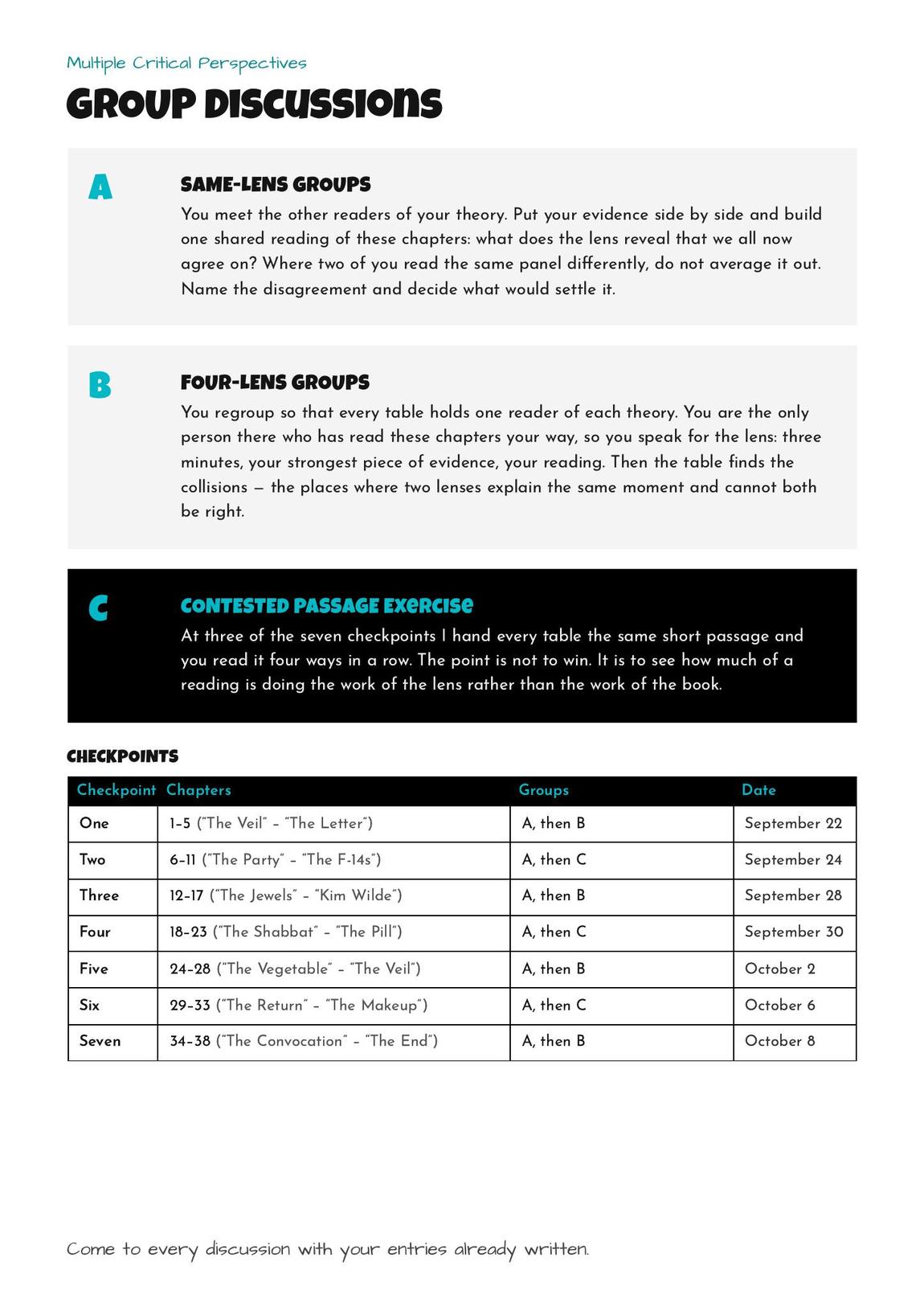
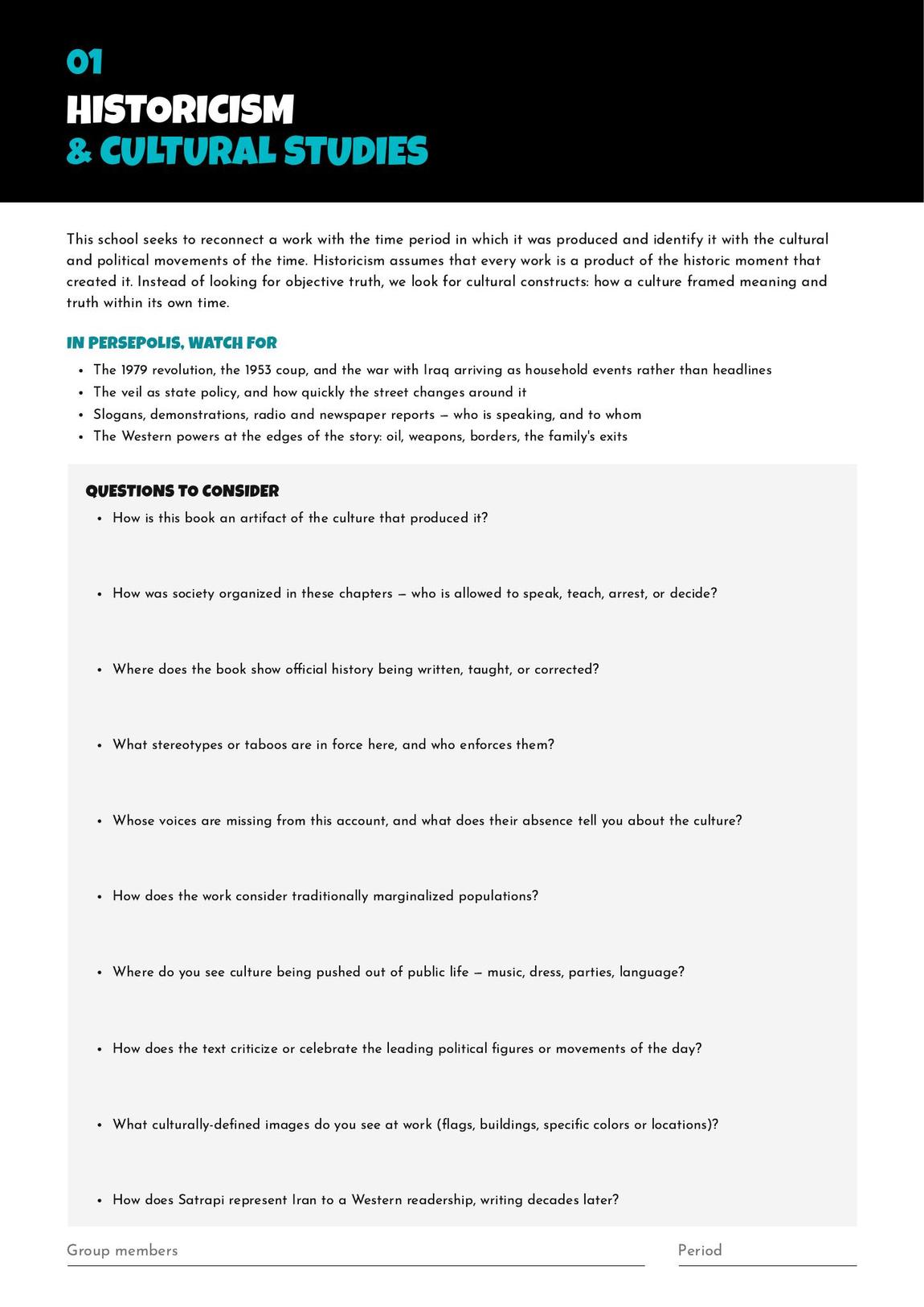
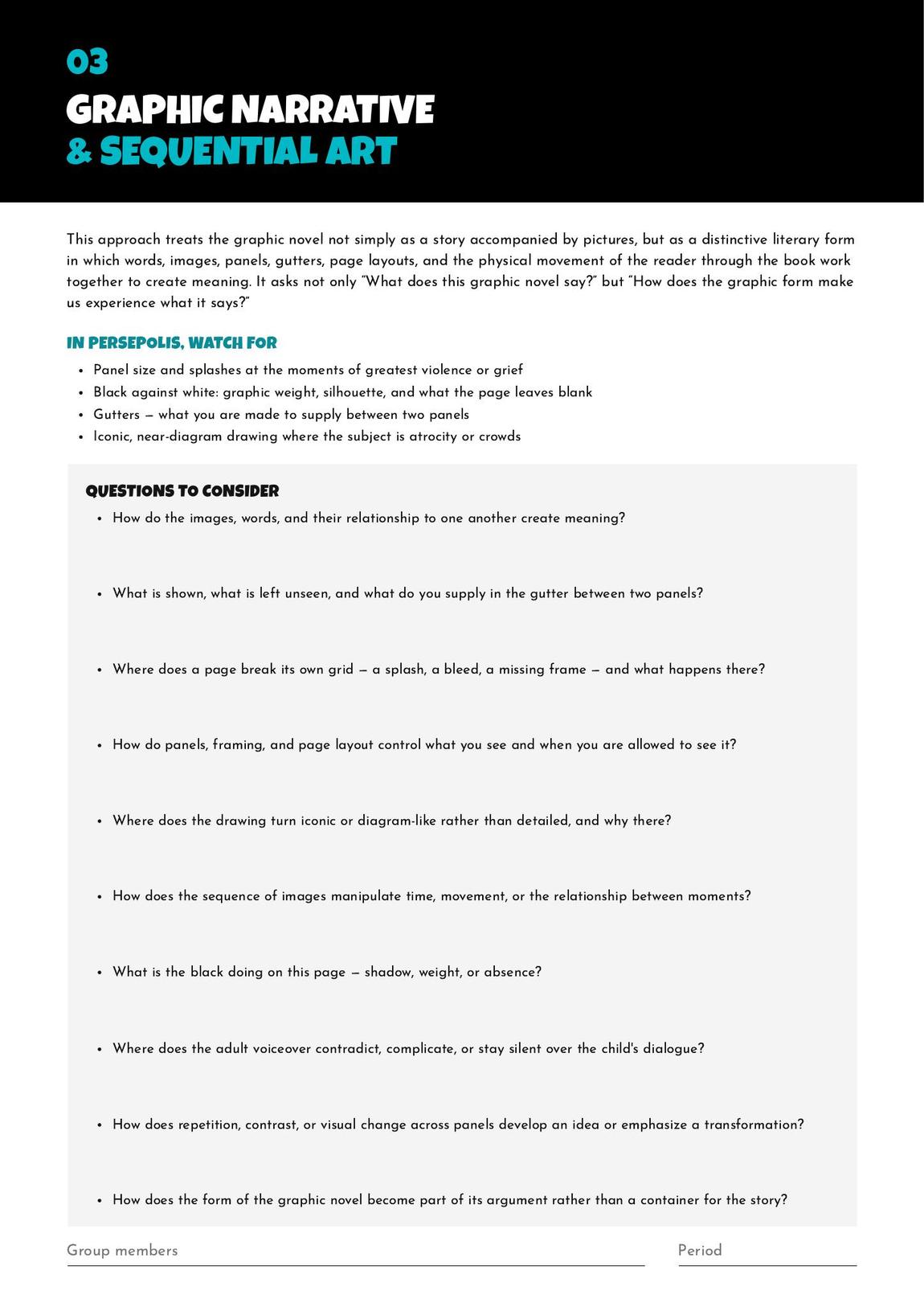
Five pages of the unit
The problem
Literary theory is usually taught as a vocabulary lesson. Students get a week of definitions — here is Marxism, here is feminist criticism — write one paragraph applying a lens to a text, and never use any of it again. The lenses stay decorative, because nothing in the classroom actually depends on which one you hold.
And a whole-class novel discussion has its own failure mode: thirty students who have all read the same chapters the same way, taking turns to agree. There is no reason for any particular person to speak, because anyone could say what they are about to say.
What I changed
Each group is assigned one theory and reads the entire novel through it — historicism, feminist criticism, graphic narrative, or Marxist and socio-economic. Not a paragraph. Thirty-eight chapters, seven checkpoints, six weeks.
The brief is uncompromising: by the end you should be able to argue a reading of the book that only your theory could have produced. That single sentence does more work than any amount of instruction, because it rules out the safe general reading a student might otherwise fall back on.
Then the discussions run twice over. First in same-lens groups, where readers of one theory build a shared account — and where the instruction is not to smooth over disagreement: do not average it out. Name the disagreement and decide what would settle it. Then in four-lens groups, where every table holds exactly one reader of each theory, so each student is the only person present who has read those chapters that way. They speak for the lens, three minutes, strongest evidence. Then the table hunts for collisions — the moments two lenses both explain and cannot both be right.
The point is not to win. It is to see how much of a reading is doing the work of the lens rather than the work of the book.
The contested passage
That line comes from the exercise that makes this a theory unit rather than a group project. At three of the seven checkpoints, every table receives the same short passage and reads it four ways in a row.
Done once, it is a party trick. Done three times across six weeks, students start noticing that some passages yield richly to all four lenses and others resist three of them, and they begin to ask why. That is a knowledge question arriving inside a literature lesson — theory produces readings, which is exactly what makes it powerful and exactly what makes it suspect.
Why this book
The Complete Persepolis was chosen because it rewards all four lenses without strain. The revolution and the Iran–Iraq war arrive as household events, which is historicism's gift. The veil is simultaneously state policy and a thing women refuse, redefine and negotiate, which splits the feminist reading open. The family's maid, passports and private schooling make class impossible to ignore. And it is drawn in black and white, so the graphic narrative lens has gutters, splashes and silhouette to work with on every page.
The lens cards are built for the book rather than borrowed: each one pairs the general theory questions with a short in Persepolis, watch for list — Mehri and the argument about who may love whom; the panel where Marji is drawn split down the middle, geometric on one side and flowered on the other. That is what makes an abstract question usable on a Tuesday.
What's in it
- The unit deck — eleven slides covering the book, the method, the discussion formats, the checkpoint schedule, and all four lens cards in full
- The printable handout — the same material as a six-page student document, one lens card per page with space for group members
- The evidence tracker — a shared document with a table per checkpoint: chapter, evidence by page and panel, interpretation, and who logged it
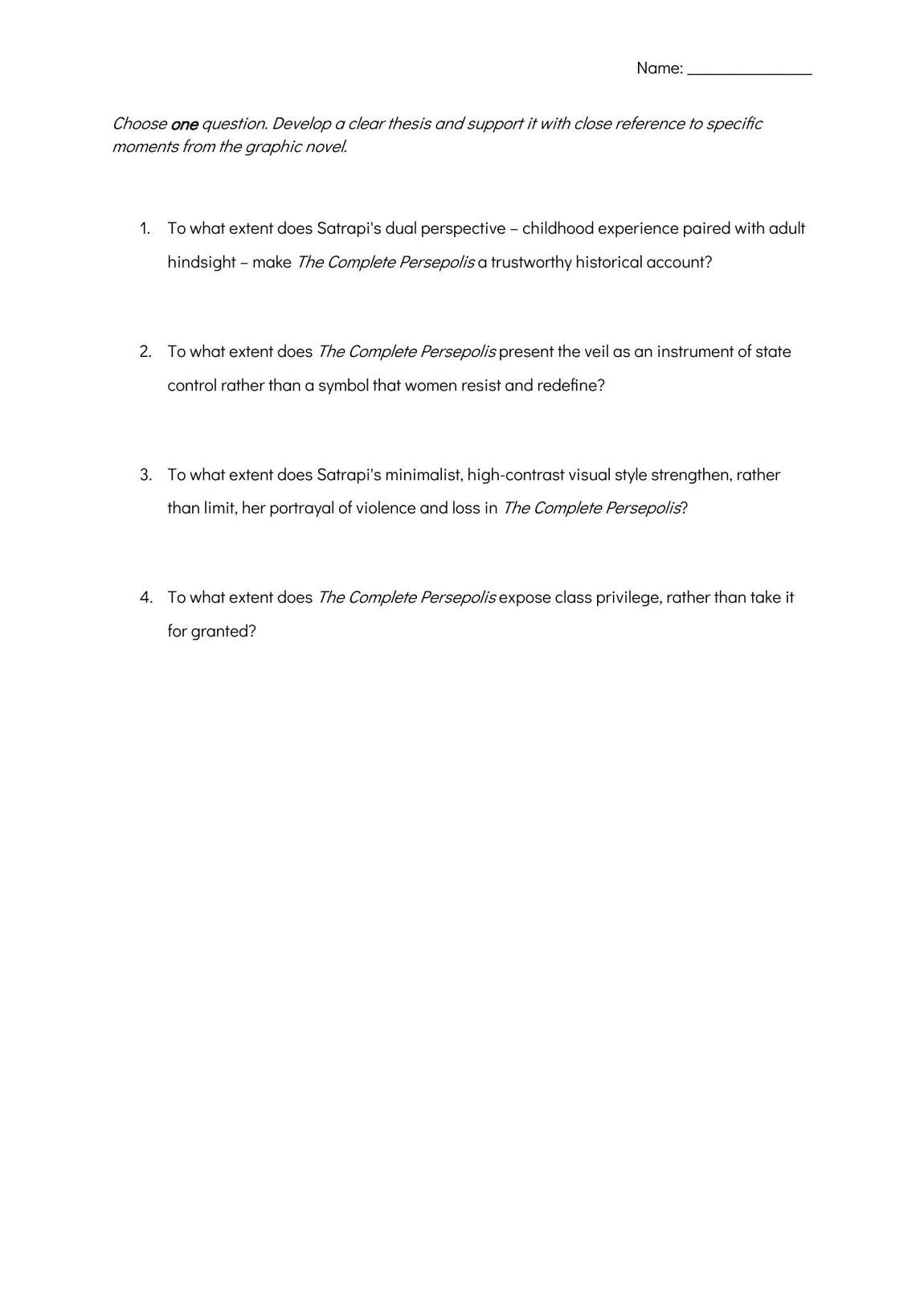
- The summative assessment — three versions, four questions each, with every version covering all four lenses. Give different versions to different periods and every student still has a question written for the lens they read
The tracker's instruction is small and worth noting: read your colleagues' entries before you write, and don't claim a moment somebody already has — find another one that does the same work. It ends free-riding and forces the group across the whole text.
Who it's for
DP Year 1 Language & Literature, SL and HL, as a full-length work study. It runs across roughly six weeks with fourteen scheduled discussions, and the deck carries dates from a real cohort — change them to your own calendar first.
The structure lifts cleanly onto any novel that rewards several lenses. Swap the watch for lists and the checkpoint chapter ranges, and the machinery works unchanged.
Students will need the RIZZ paragraph frame or something like it for the summative; it's built into Image as Text and the Owen IO unit.
Acquire
$7 One teacher · deck, handout, tracker and three testsThe deck and tracker are delivered as Google files that copy into your own Drive, editable — change the dates, swap the lenses, adapt the checkpoints to your chapter pacing. The handout and assessments come as documents. Department licenses available for whole-team use; reply to the checkout email and I'll sort it.
Take it from the shelf