The Collection / Language & Literature
Language & LiteratureIt's Funny Because It's True
Stand-up comedy as a non-literary text: how comedians use language to carry serious social commentary, studied across a comedian's whole body of work — and ending with students writing and performing a routine of their own.
Five views of the unit
The problem
Non-literary text units tend to reach for the same things: advertisements, speeches, infographics, opinion columns. Students learn to analyze them dutifully and never think about them again. Meanwhile they spend hours every week watching a text type that is densely crafted, rhetorically sophisticated and frequently political — and nobody has ever asked them to take it seriously.
Stand-up also poses a genuinely interesting analytical problem. Explaining a joke is famously how you kill it. A student who can take a bit apart and show exactly why it works, without losing sight of why it was funny, has done something harder than most commentary on a speech.
What I changed
The unit goes broad first and then deep, deliberately.
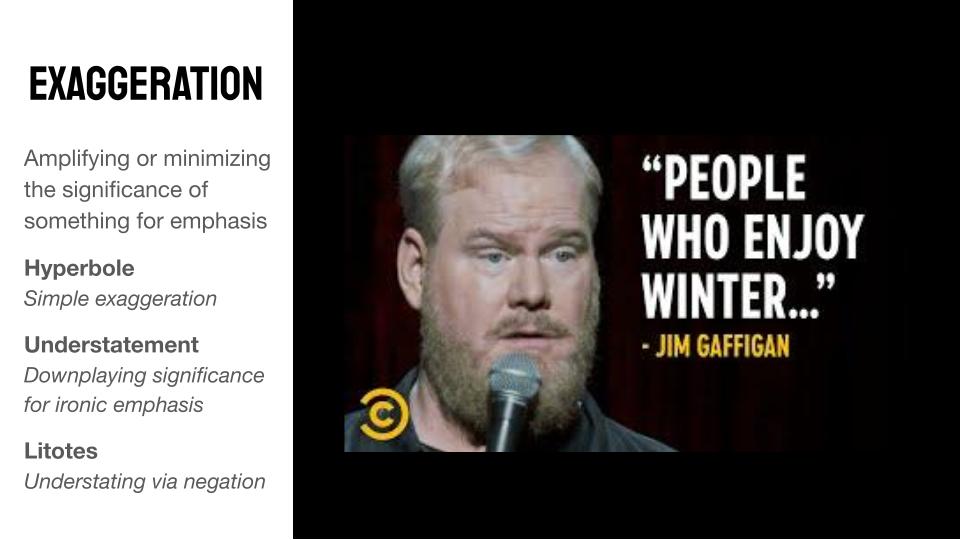
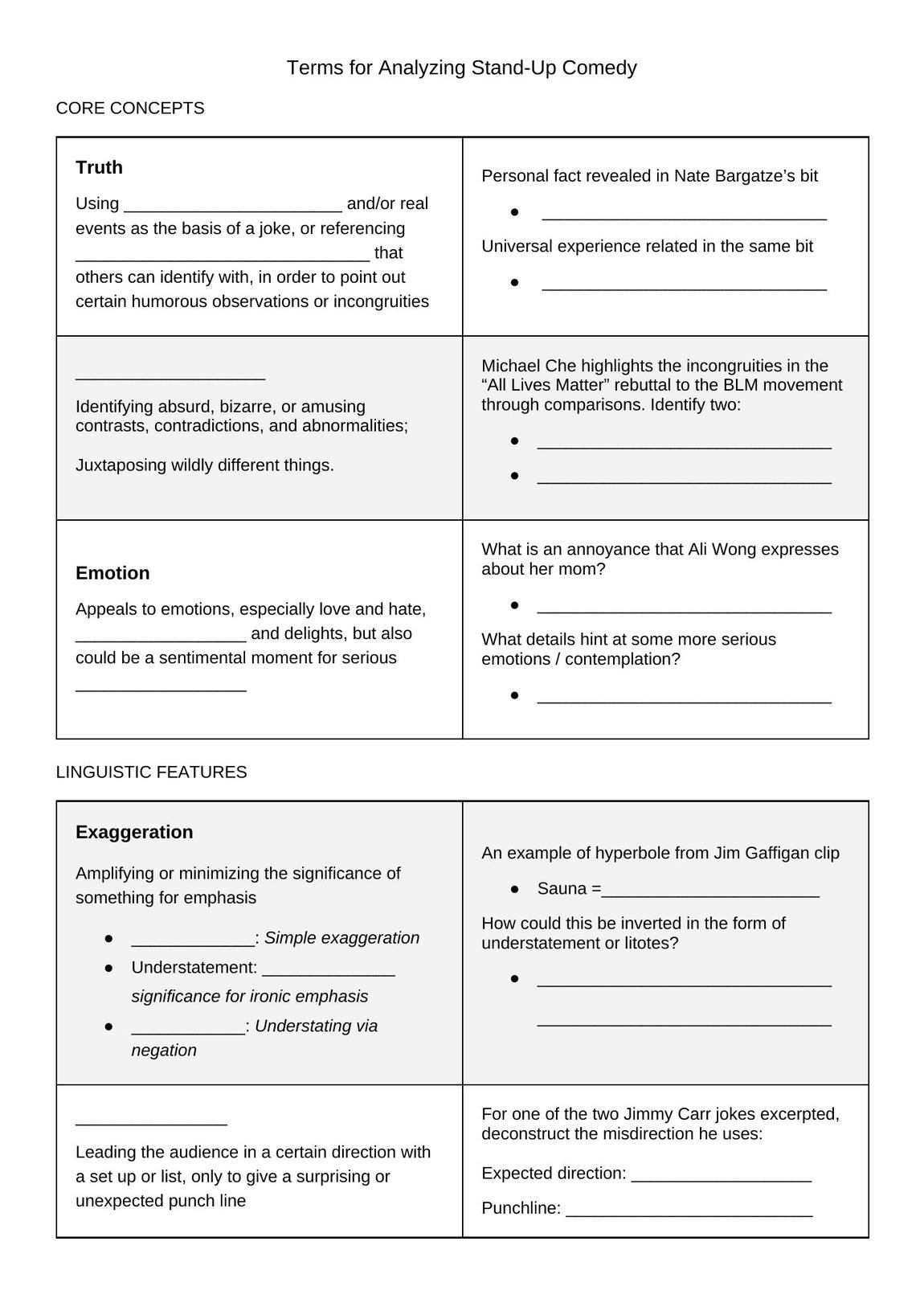
Broad: three core concepts — truth, incongruity, emotion — and fourteen linguistic features, from misdirection and the rule of three to backdowns, callbacks and paralanguage. Each one is taught through a clip, and almost every clip comes from a different comedian. By the end of the terms sheet students have seen the devices working across close to twenty comics, which is what stops them confusing one performer's habits with the rules of the form.
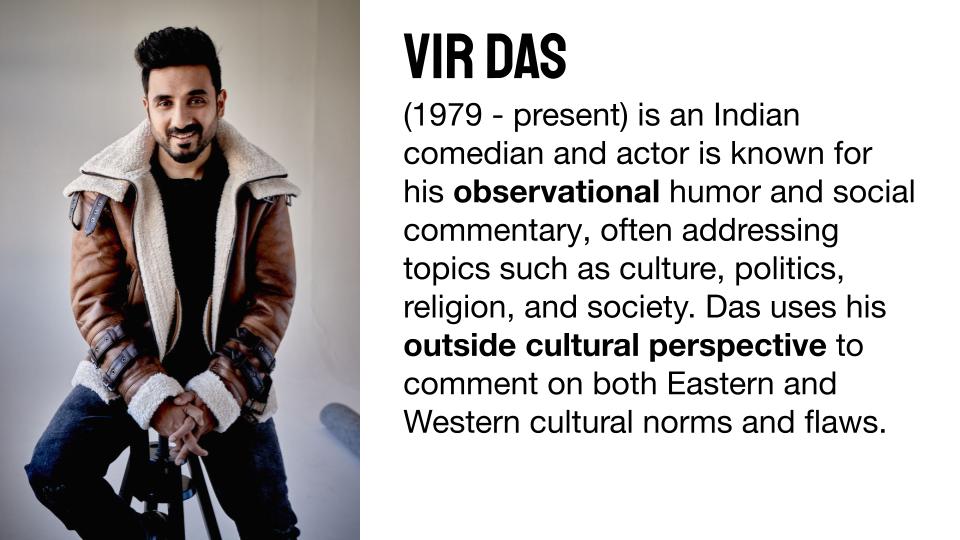
Deep: then each student commits to one of five comedians and watches two full-length specials, which together constitute a body of work. The five are chosen for range — George Carlin's linguistic humor and taboo-breaking; Ellen DeGeneres's clean observational comedy and what it cost her to come out; Vir Das commenting on East and West from outside both; Iliza Shlesinger's physical comedy on dating and body image; Trevor Noah's storytelling about race and politics from South Africa. Students choose only after watching a short late-night set from each, so the choice is informed rather than a guess from a name.
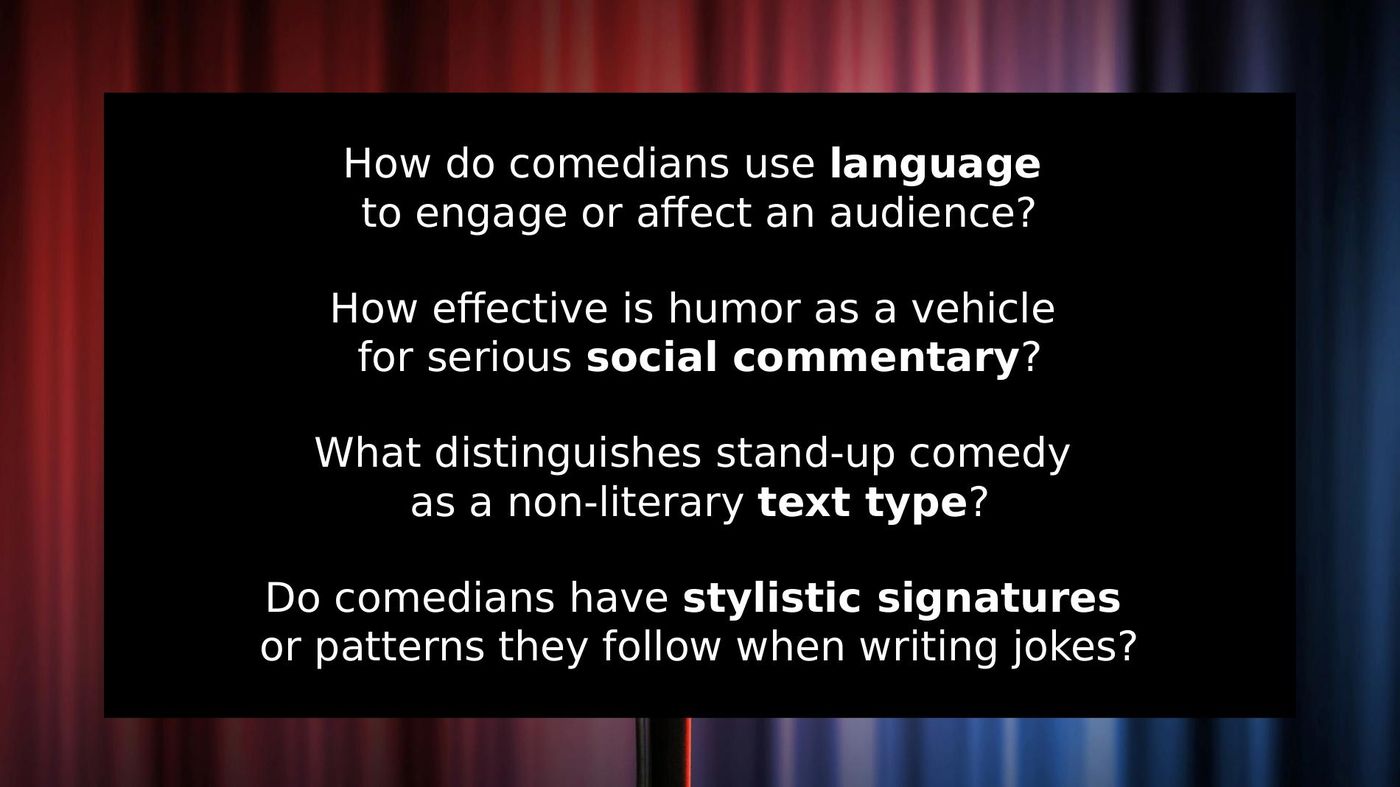
Do comedians have stylistic signatures or patterns they follow when writing jokes?
Close reading, twice, differently
The two close-reading sheets look parallel and aren't. For the first special, students choose four extracts on four different topics, annotate three to six distinct features in each, and write an argumentative thesis about how the comedian uses language — one for each half of the special.
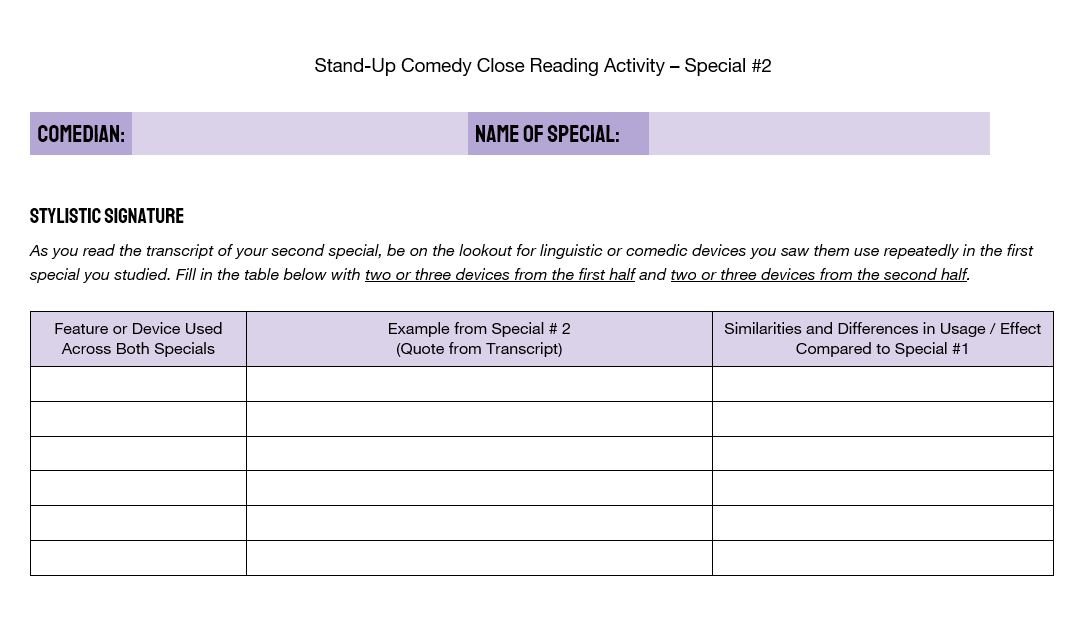
For the second special, the task changes. Students hunt for the devices that recur across both specials and compare how each is used. That's the move from analyzing jokes to analyzing a comedian: the recurring devices are the signature, and the differences in how they deploy them are where the argument lives. It's the same body-of-work thinking as the cartoonist portfolio in Image as Text, applied to performance.
Transitions are the secret curriculum
One short deck does a lot of quiet work. It shows how comedians open a set — direct address, a nod to the city, easing in or diving in — and then shows real transitions from the case-study transcripts, each labeled with the move being made: airports to California restaurants, old people in Florida to kids' obsession with candy, dyslexia to religion.
The three techniques are ones students already half-know from essay writing — a transitional phrase, a repeated key word, a juxtaposition — but in comedy the stakes are visible. A bad transition in an essay costs a mark. A bad transition on stage is silence. Students who would never study essay transitions willingly will study these, and the skill carries straight back.
Then they perform
The unit ends with students writing, annotating and delivering an original routine. The rubric's lowest band for structure names exactly the failure you'd expect — more a series of jokes than a coherent routine — which is also, word for word, what goes wrong in a weak essay. The top band asks for organic transitions and a clear sense of purpose. The language criterion asks for more than five annotated devices plus deliberate control of pacing and paralanguage.
Annotating their own script is what makes the performance assessable rather than a talent show. A student who isn't naturally funny can still score well by showing, in the margins, exactly which devices they chose and why.
What's in it
- Unit overview deck — 45 slides: guiding questions, core concepts and linguistic features each with an embedded clip, the five comedians, five late-night sets for choosing, and links to transcripts for all ten specials
- Introductions and transitions deck — 12 slides of real openings and transitions from the case-study specials, with the conventions set out
- Terms sheet — cloze definitions for every concept and device, each paired with a question about a specific clip
- Close reading, special one — four annotated extracts and two argumentative theses, with a Criterion B rubric
- Close reading, special two — the stylistic signature comparison across both specials
- Performance rubric — Criteria C and D for the original routine
The overview deck is delivered as Google Slides so the clips arrive embedded and working. Everything else comes as editable documents.
A note on content
Stand-up is an adult form and this unit does not pretend otherwise. Several clips and transcripts contain strong language and mature subject matter, including race, sexuality and religion — which is much of why they are worth studying. Preview everything against your own school's context before you show it, and treat the clip list as a starting point rather than a fixed syllabus. Every clip slide is a single link you can swap.
Who it's for
DP Language & Literature, SL and HL, as a non-literary text unit. It runs across several weeks, with the specials watched at home and close reading done in class.
A comedian's specials also make a strong non-literary body of work for the Individual Oral — a coherent set of texts by one creator, with a global issue usually sitting right on the surface. If your students are building toward the IO, the close-reading sheets are already doing the preparation; the Owen IO unit shows the other half.
Acquire
$10 One teacher · two decks, three handouts, two rubricsThe overview deck copies into your own Drive with every clip embedded; the rest arrive as editable Word and PowerPoint files. Department licenses available for whole-team use — reply to the checkout email and I'll sort it.
Take it from the shelf